The Skjelfjord Story
The 2nd Battle of Narvik was a significant battle where most of the German naval fleet were destroyed. HMS Eskimo had her bow blown off but manage to make it back to the UK and was rebuilt. HMS Cossack has significant damage and went aground but even so managed to put a German field gun out of action. When re-floated she sailed for Skelfjeld in the Lofoton Islands to join 10 other RN vessels that used the fjord. The Norwegians helped to repair several damaged ships before the ships made their way back to the UK. The local people have erected a stone memorial to the event.
Extracted from reports in M08047, other official files, Naval History Net and Geirr Haar –
10th April 1940
HMS Hostile towed damaged sister ship HMS Hotspur to Lofoten for temporary repair arriving at 1640. The local Mayor (Landaman) came aboard and gave information of German presence at Bodo and Grono – Warships and a tanker. This was subsequently found to be exaggerated.
11th April 1940
During the Forenoon (0800 – 1200) a fishing boat from Reine arrived with a Mr Hartvig Sverdrup, his sister and his brother in law – Mr Paul Koht (son of the Foreign Minister of Norway). They gave untold assistance. They sent for oxy-acetylene cutting plant from Reine. They arranged for the wounded to be to Gravdal Hospital.
Mrs Kont very kindly went with the doctor and sick. They got in touch with the civil engineers on a local harbour works and arranged for them to come the next day to repair HMS Hotspur. They telephoned the authorities up and down the coast and asked them to send all local intelligence to Skjelfjord. They also provided local boats for transport in the fjord.
HMS Penelope towed to Skjelfjord by HMS Eskimo. (She was damaged by running aground off Flienver near Bodo)
12th April 1940
HMS Hostile left the fjord at 0400 owing to bad weather and at this time Penelope and Eskimo were sighted entering the fjord. Mr Sverdrup telephoned for the salvage tug. Penelope then took over the duties of “Base Ship – Skjelfjord “
13 April 1940
ESKIMO took oil from RFA British Lady and sailed from Skjelfjord at 0015 for passage to Trannoy Light arriving at 0500 14 April. (File M08336 Op DW) HOSTILE and HAVOCK to protect Skjelfjord. (File M011887/40 refers). Later ordered by Battle Commander to proceed to Narvik to assist. IVANHOE remained to guard Skjelfjord until also ordered to Narvik
14 April 1940
HMS Kimberley arrives at 0400 and sails at 1245 after transferring wounded to Penelope. HMS Cossack arrives at 1645 with escort HMS Forester. (68° 00’N 13° 15’ E.) Cossack transferred her ammunition to HMS Zulu and her torpedoes to HMS Bedouin.
15 April 1940
HMS Eskimo arrives at Skjelfjord at 0600 towed by HMS Bedouin and escorted by HMS Hostile and HMS Ivanhoe. She was berthed alongside the ex -German ship Alster
HMS Punjabi arrived at 1406 -15 April 1940. Took on oil from RFA British Lady and made temporary repairs assisted by the Engineer Officer of Penelope and four Engine Room Artificers from Eskimo. Proceeded to sea at 1915 for half an hour to commit her 6 dead to the sea.
Before COSSACK, HOTSPUR and PUNJABI sailed the Captain of ESKIMO obtained from them 6 shackles of different sizes cable and one anchor and ordered BRIGAND to lay it out with the ends buoyed in a corner of the fjord. These were used during bad weather or when there was no ship to secure to.
16 April 1940.
The following members of ESKIMO’s ship’s company were buried at sea from HMS Grenade.
CERA H. J Mobley C/M 39435
PO Cook F. N Edney C/MX 45388
AB W.W. Morgan C/JX 133780
AB E. Bolton C/SSX 25385
AB C.G. Riley C/SSX25385
Stoker S.A. Hamilton C/KK95515
Stoker L.T. Routledge C/KK 95515
Stoker J.D, Telford C/KK94828
20 April 1940
After emergency repairs HMS Punjabi departs forenoon (Between 0800 and 1200) for Scapa Flow in company with HOTSPUR and JUPITER
23 April 1940
Cossack departs Skjelfjord at 2300 with tanker WAR PINDARI. (HF WD, HF D WD and movement books refer)
24 April
ALSTER leaves.
The following members of ESKIMO’s ship’s company were buried at sea from HMT (Her Majesty’s Tug) Danesman.
ERA R.W Wheelright C/MX60350
2 May 1940.
The following members of ESKIMO’s ship’s company were buried at sea from HMT Black Fly
W. Kindness C/SSX 26813
Stoker S.L. Andrews (Official number not known)
5 May 1940.
The following members of ESKIMO’s ship’s company were buried at sea from
HMT Black Fly.
AB R.A. McPherson C/SSX17511
7th/8th may 1940.
Bandit and Buccaneer arrived at Skjelfjord during the night of They should have left during the 9th, but were delayed due to poor weather.
10 May 1940
First bombs dropped on Skjelfjord. From 10 to 13 May about 63 bombs dropped on the fjord but did not hit any ships. A request was received from the Norwegian Authorities to move the ships away from the village. A reply was sent but no action taken to remove the ships. Lt Richie with one Petty Officer and 8 men landed to capture the crew of an enemy bomber which was reported by Norwegians to have crashed near the fjord. This report had no foundation.
After the aircraft left, preparations to depart commenced and just before midnight on the 10th, Bandit towed Penelope out of Skjelfjord while Buccaneer towed Isis. Destroyers Campbell and Witch followed as escort with trawlers St. Loman and Lunar Bow. Transports Sea Valour and Lochee also joined. AA cruiser Calcutta waited outside and took charge of the convoy. Destroyers Grafton, Burza and Blyskawica sailed an hour earlier, searching the main fjord for U-boats, but did not wait for the convoy.
Coventry with Rear Admiral Vivian joined at 11:30 next morning, shortly after which another German air attack on the ships took place. Again there were no hits, but a stick of (presumably) 250 kg bombs landed between Bandit and Penelope, showering both ships with splinters and water. No one on board any of the ships was hit. Bandit and Penelope arrived at Greenock on the 16th May.
11 May 1940
VINDICTIVE sails leaving ESKIMO, three trawlers and the collier BALMAHA
13 May 1940
HMS Coventry arrived
14 May 1940
ESKIMO was towed by HMS Vindictive to the southern end of Tjelsundet.
18 May 1940
A party consisting of Lt Ritchie with one Petty Officer, two Able Seamen, one Stoker, two privates of the Irish Guards and two privates of the Royal Engineers manned a Norwegian motor fishing boat took military stores from Harsted to Bodo and returned on 21st May.
10 to 13 May
approximately 63 bombs were dropped of which 12 fell within fifty yards of ESKIMO
On the 27th May, Bandit took Eskimo out of Harstad harbour. The two ships were tied alongside each other. Having passed the narrows the towing commenced, with the destroyer stern first. Transport Devon City and cable ship Lasso joined as did the sloop Fleetwood. Also the captured Alster fell in for a while, but when safe from German aircraft, the other ships increased speed, leaving Bandit and Eskimo behind. The two reached Barrow-in-Furness on the 4th June.
Additional information but no dates
Other possible vessels not mentioned above – Trawler India Star, HMS Matebel, HMS Zulu
There was signal traffic that PENELOPE was going to have to beach herself as she was unable to contain the flooding during bad weather in Skjelfjord
A B1 net laid in Skjelfjord – Boom net – anti torpedo / submarine?
18 May 1940. A trawler force under Lt Cdr W. R. Fell may have arrived – no date for leaving
Son of Walter Fell, MD Oxon, and Margaret Richmond.
Married 1st (1921; divorced) Phyllis Munday, daughter of Maj.Gen. Richard Cleveland Munday, CB, MRCS, LRCP; two sons.
Married 2nd Jean Dunkerley.
31.01.1897
Wellington, New Zealand
28.11.1981
Eastbourne, Wellington, New Zealand
Dear Geirr,
I can’t thank you enough for getting back to me, and for all the information, which has certainly clarified things a lot. I wasn’t previously aware of the air attack on the 11th, or of Bandit and Eskimo being ‘left behind’ on the 27th, and the detail on convoy escorts etc.
Congratulations on your very detailed research and I trust that your book is being well received, I am really hoping that one day you will be able to release an English version.
Thank you also for the two photos. I do have a number of Bandit, primarily inherited from my father. I’m attaching one which looks as though it was an ‘official’ photo, date and location unknown, but certainly not Sjkelfjord!
My research into other aspects of Bandit’s operations is going well. I’ve had a really interesting week, researching Bandit’s involvement in neutral Ireland with SS Eros (you may have read Guarding Neutral Ireland by Michael J. Kennedy) which mentions Bandit several times.
And further reading with ‘Nightmare at Scapa Flow’ by HJ Weaver, which provides confirmation from the Pink List and Bandit’s log that she was definitely in harbour during the U-47 attack. Dad was a young engineer, 22 years old, just out of apprenticeship. He was appointed ERA on 3 Oct 1939 so he had only been on duty 10 days. The reality and horror of war would have been brought home to him in a major way.
All the best, and thanks again for your help
Kind regards
David Beard
Dear Mr. Beard
The information I have, is that Bandit and Buccaneer arrived at Skjelfjord during the night of 7th/8th may 1940. They should have left during the 9th, but were delayed due to poor weather.
On the 10th, the German aircraft arrived. They bombed, but did not hit any ships. As both tugs were there, it is very likely that they experienced some near misses, but I do not have any direct accounts of that.
After the aircraft left, preparations to depart commenced and just before midnight on the 10th, Bandit towed Penelope out of Skjelfjord while Buccaneer towed Isis. Destroyers Campbell and Witch followed as escort with trawlers St. Loman and Lunar Bow. Transports Sea Valour and Lochee also joined. AA cruiser Calcutta waited outside and took charge of the convoy. Destroyers Grafton, Burza and Blyskawica sailed an hour earlier, searching the main fjord for U-boats, but did not wait for the convoy.
Coventry with Rear Admiral Vivian joined at 11:30 next morning, shortly after which another German air attack on the ships took place. Again there were no hits, but a stick of (presumably) 250 kg bombs landed between Bandit and Penelope, showering both ships with splinters and water. This may well be the incident you refer to. No one on board any of the ships was hit. Bandit and Penelope arrived at Greenock on the 16th May.
On the 27th May, Bandit took Eskimo out of Harstad harbour. The two ships were tied alongside each other. Having passed the narrows the towing commenced, with the destroyer stern first. Transport Devon City and cable ship Lasso joined as did the sloop Fleetwood. Also the captured Alster fell in for a while, but when safe from German aircraft, the other ships increased speed, leaving Bandit and Eskimo behind. The two reached Barrow-in-Furness on the 4th June.
That is what I have on the movements of Bandit during this period. Hope it is of any use.
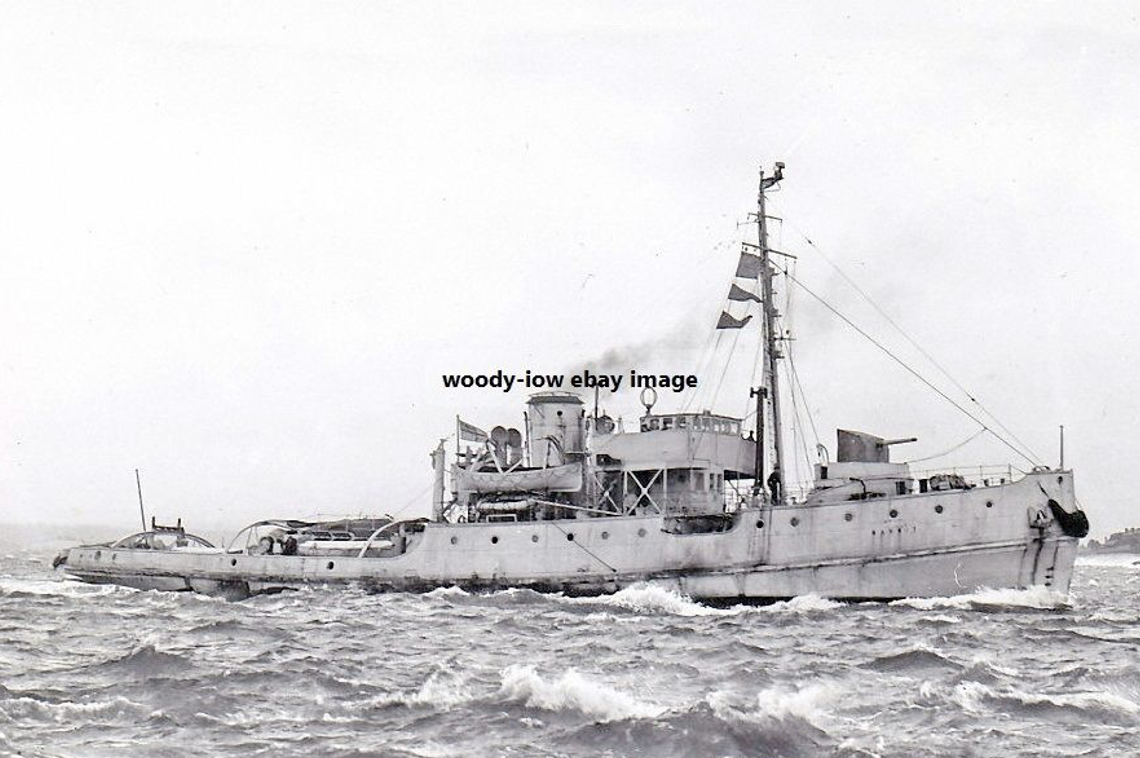
I have no photos of Bandit, but have enclose one of Buccaneer, which was rater similar in appearance. On the photo, she has a practice-target attached to her side which would be towed (far) behind when in use. Both ships were engaged in this activity from time to time.
You will find a replica photo of Bandit here: http://www.ebay.co.uk/itm/rp15185-Royal-Navy-Tug-HMS-Bandit-built-1919-photo-6×4-/361374852500
All the best
Geirr
Dear Geirr
Many thanks for getting back to me through Keith Batchelor, who has given me your email address.
I’m presuming that Keith has forwarded to you my email to him, and that you are aware of my strong interest in anything related to HMS Bandit, and my understanding of her movements and rescue role with both HMS Eskimo, and HMS Penelope in Norway in mid 1940.
My father Roy Beard, served on HMS Bandit from 4 Sep 1939 to 20 Dec 1946. He was the ERA and from 1945 was Engineer Officer-in-Charge. During his life he made limited mention of his war service, and I am currently attempting to research the Bandit and its role during WW2, primarily using on-line sources, but also from any books that I can find, including of course your interesting account of The Battle for Norway, and also a very recent book “The Tattie Lads” by Ian Dear decribing the role of rescue tugs during WW2.
Dad did make brief mention of his experiences in Norway, particularly the cold! but also the beauty of the fjords, but unfortunately nothing about Bandit’s operations.
From what I gather from exchanging emails with Keith, our understanding of the movements of Bandit align with your account of events. However one new piece of information that has emerged is that Bandit had a near miss from a 250 kilo bomb which sent splinters over the ship? This presumably happened at the same time that HMS Penelope had a near miss?
If you are able to provide confirmation or otherwise of the above, and my understanding of Bandit’s movements, I would really appreciate it. And if you have any photos that you could make available that would be fantastic!
I’ve seen the preview of your new book, but since English is my only language I have to rely on Google for translation, which makes reading quite difficult. I wondered if you had any plans to publish an English version of the book? It would probably have a limited audience outside of Norway though, and is perhaps the reason why you haven’t gone down that path
Regardless, I hope that your new book is well received – it tells an important story.
Thanks in advance for any help you might be able to provide
Kind regards
David Beard