0040 ROCHESTER on H/F D/F detected a U-boat making a first sighting report of the convoy bearing 061° or 241°. She presumed that this was the same U-boat which had previously been sighted by the VIDETTE.
0540 LAMERTON heard noises which were exactly like an echo-sounder working; these continued for an hour. A report was made to COSSACK at dawn and the two ships swept back six miles and then re-joined the convoy without contact.
Weather
Wind NE Force 2
Weather Clear
Sea Slight sea and swell
Visibility 3-5 miles
2210 Hands at Action Stations. Speed 13 knots. Alarm Green 30 was passed. Depth Charge Party closed up and stood by to prepare a pattern. Defence Stations was ordered (2230). 2300 went to action stations to search for a reported submarine. Nothing was found so she returned to her position in the convoy. Ray Davies reports that they were warned of going to Action Stations at 2359 so went for a wash (in a bucket). He noticed Jack Heather’s identity disc on the deck. He called too him but Jack told him to keep it until after action stations. Jack was killed on ‘A’ gun.
2306 Whilst stationed on the starboard bow of the convoy CARNATION sighted a U-boat on her starboard quarter at a distance of 1000 yards. CARNATION altered course towards and increased to full speed with the intention of ramming. An R/T message was immediately transmitted and this was answered by COSSACK.
2308 The U-boat dived but A/S contact had been gained and two minutes later CARNATION dropped a five-charge pattern set to 50 feet. After this attack contact was lost and a hunt was commenced. Meanwhile BLUEBELL who was stationed on the starboard beam had received the R/T report and altered course to close the position. No contact could be obtained so at 2316 a pattern of five charges, set to 50 feet, was dropped some 500 yards from the position of CARNATIONS attack, which had been marked by a calcium flare. An A/S sweep was then commenced down the starboard side of the convoy. All other escorts appear to have carried an ASDIC and starshell search in accordance with Captain (D)’s orders. “If at night the side of attack is indicated the corvettes on that side will turn outwards and sweep for two miles using starshell and snowflakes and if nothing is sighted will then re-join the screen. Destroyers in the positions on the bow and quarter of the convoy will search inwards and then outwards in their respective sectors using starshell”
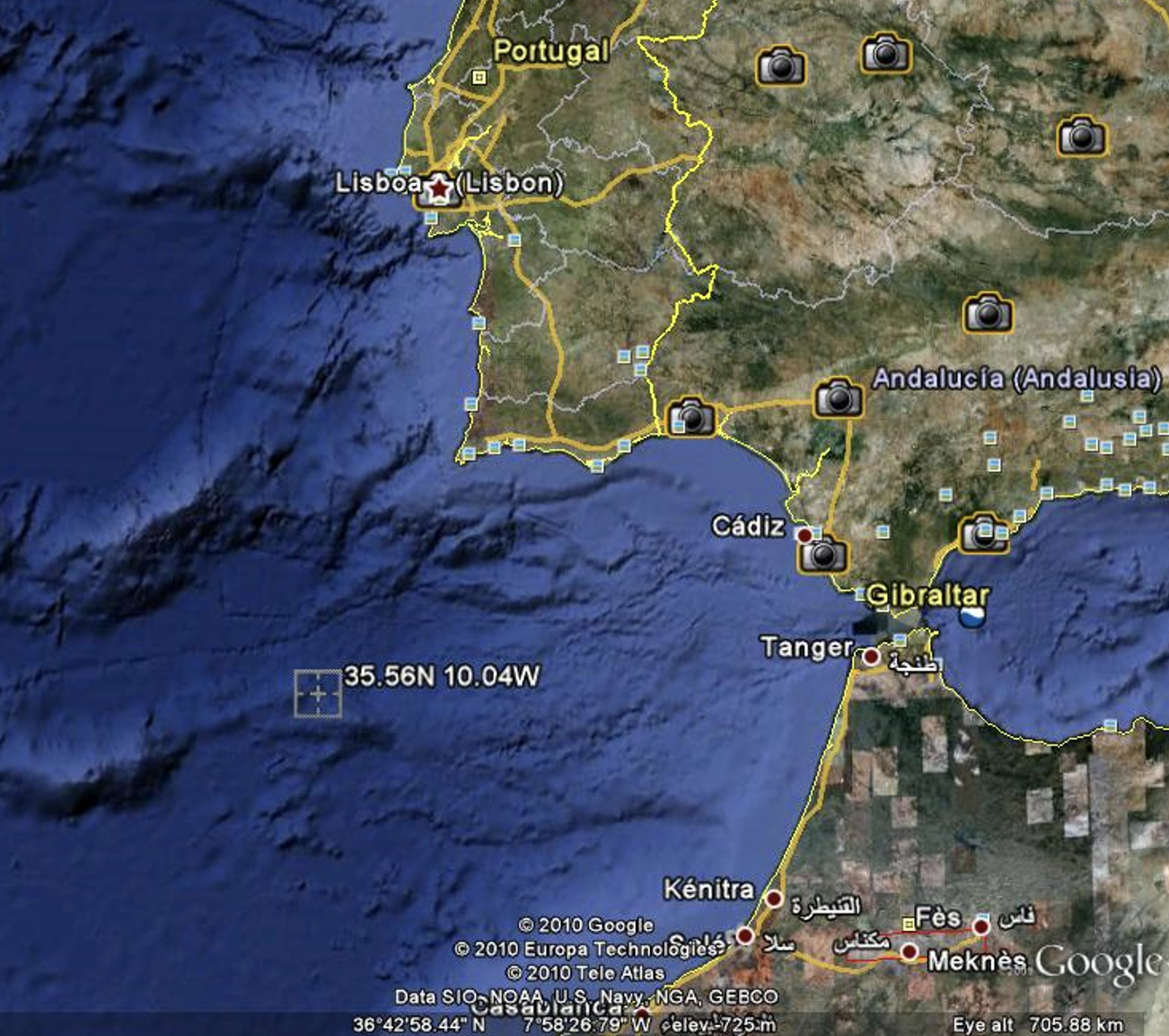
Torpedoed by U563 (Lt Klaus Bargsten) 35.36 N 10.04 W at 2337 whilst stationed astern of the convoy and proceeding at 13 knots.
Extract from some information concerning the rescue of the survivors of HMS Cossack, from French official maritime history.
Extracts translated from : CRAS Hervé, MANGIN D’OUINCE Xavier, MASSON Philippe : Les bâtiments de surface des F .N.F.L.. Marine Nationale, Service Historique, Paris, 1968, pp. 122 – 125.
They report that, from Gibraltar, the 22nd of October 1941, the convoy had to take a route of 262° from Spartel Cap, south of Tanger. [Cap Spartel is a promontory in Morocco about 1,000 feet above sea level at the entrance to the Strait of Gibraltar, 12 km West of Tangier. Below the Cap are the Caves of Hercules] They had to follow this route until midnight the 23rd to join 10° West at about 190 nautical miles from the Cap.
The aviso Commandant Duboc (minesweeper aviso type Élan, 630 t.), from the Free French Navy, left Gibraltar the 22th of October 1941, with the escort of the convoy HG75. The 23th, at 2335 (11.35 pm), it was seen a red rocket at about 3000 m ahead on starboard and few minutes later, a ship on fire. The aviso headed for this ship at maximum speed. At 2347 (11.47 pm), the aviso arrived near a destroyer in fire (HMS Cossack) assisted by another. The aviso collected 5 men on a raft and 16 other (including Lieutenant MOTH) on another (total = 21). The shipwrecked were exhausted, paralyzed by cold, and poisoned by oil. Several Free French sailors went into the water to rescue them.
They give as position of the shipwrecked from Cossack at midnight the 23rd : 35° 23 North – 9° 48 West.
The 24th, at 0410 (4.10 am) 22 survivors of cargo ship Carsbreck were rescued. At 0600 (6 am) 34 survivors of cargo ship Alhama were rescued. After 0700 (7 am) the Commandant Duboc transferred all these survivors either onto the passenger ship Ariguani (52) or onto sloop HMS Rochester (15).
Extract from –Boat Attack Logs Daniel Morgan & Bruce Taylor (ISBN 978-1-84832-118-2)
Kriegsmarine code (of attack) Quadrat CG 8813. U-boat timekeeping differential +2 hours. Sighted by U71 and U563 on 23rd October 1941. Shortly after 2200 GMT corvette CARNATION reported a submarine sighting and the entire escort went to Action Stations. When the tentative ASDIC contact faded and nothing more was sighted COSSACK stood down to second degree readiness and took station astern of the convoy. About 15 minutes later a torpedo was seen approaching the port side. This immediate alteration was only sufficient to avoid one of the pair of torpedoes fired by U563 and hitting COSSACK at 2238 GMT.
U563 War Diary
Commanded by Oblt.z.S Klaus Bargsten
Qu. CG 8821. Wind NNW 2. Sea 1, 5/10 overcast. 1,016mb visibility 3 nm.
0014 Four torpedo detonations heard in boat. We sight explosion clouds and shining light at bearing 285° true. (These may have been depth charge attacks carried out by CARNATION following a contact around this time)
0018 Several steamers in sight at bearing 285° true. We alter course towards them. Precise formation cannot yet be determined but we fire a spread of two torpedoes at the largest of them, range 3500 m. Due to a switching error we only get one torpedo away. After 4 min. 30 sec. there is a donation together with a huge sheet of flame followed shortly after by an explosion. Explosion cloud rises 80 – 1000 m. My impression is that this torpedo detonation occurred on the far side of the steamer and that it was not mine but another boat’s torpedo which struck. A large number of starshell and rockets are then fired towards the dark side which I have now vacated. (British records show no record of torpedo attacks at this time so it may have again been anti-submarine activity elsewhere in the convoy)
0030 Ahead of me, with an inclination of 70°, bows left, appears a destroyer about 1,000 m. She is illuminating the area on the far side with her searchlight. Immediately behind her and overlapping is a medium sized steamer. Destroyer alters course, now has an inclination of 90°, bows right. (British and German sources cannot be reconciled on this point. Bargsten’s plot of the attack confirms the log data which indicates he fired when COSSACK was beam on to him on her starboard side. By contrast British records which make no reference to any starshell being fired prior to the attack on COSSACK (But see entry above at 2306 from ADM 199/1994) are unanimous that the torpedo was sighted on her port side where it struck despite the turn to starboard)
0038 Spread of two torpedoes fired. (All torpedoes during this engagement were fired by the First Officer of the Watch Oblt.z.S Klaus Peterson) After about 30 sec. she alters course once again. At first I assume this is towards us at a bearing of 0° because we can make out the white foam from her bows. It turns out that she was turning away from us and what we saw was her propeller wake. I now find myself completely illuminated by starshell, which is being fired across the entire horizon on my side.
0039 Emergency dive. As we are diving we hear two powerful torpedo detonations. Boat sinks to T = 45 m (185 m -607 feet) and we have difficulty bringing her back up. It becomes apparent that the flooding valve of the torpedo compartment was leaking. Running time of my torpedo 1min. = 900 m. So we evidently hit the steamer.
0110 We surface. Nothing more to be seen of the steamer. While we were submerged we heard the cracking noise typical of a sinking merchantman, as well as two explosions that sounded like they came from boilers going up. At a bearing of 20° true we can see a burning vessel with a destroyer and another escort vessel nearby; the destroyer is illuminating the area about her as a precaution. I assume they are taking survivors on board.
0130 Single torpedo fired from Tube V at the burning ship. No success. We then head off on a north westerly course to catch up with the convoy.
0211 Incoming W/T transmission from U71: Convoy Qu.8827 heading north. Other U-boats U-206, U-564 in the vicinity.
(U563 – Built by Blohm and Voss of Hamburg – was commissioned in March 1941 and heavily damaged by a Whitley bomber on 1 December 1941. She returned to the fray in October 1942. She was sunk 29 May 1943 in the Bay of Biscay by a Sunderland piloted by Wing Commander W.E. Oulton 58 Squadron.) Bargsten went on to command U521 which was sunk by US patrol craft PC-565. Bargsten, the only survivor, spent the rest of the war in captivity being released in 1946. He died in August 2000.
In COSSACK the Captain and 159 officers and men were killed or missing; presumed dead with 29 injured.
Jimmy Tychurst the Communications on ‘X’’ gun heard the Captain say ‘Torpedo to port.
The order ‘Hard a starboard’ was given but the ship was hit by the second torpedo just forward of the bridge between ‘A’ and ‘B’ magazine on the port side destroying the whole forward structure and setting the bridge on fire. The ready use pom – pom ammunition on the bridge was ignited.
- Second Lt passed the order to abandon ship.
‘X’ gun crew slipped the Carly float and tied it to the rail.
No 1 boiler room flooded immediately but the sprayers were shut off by the Stoker Petty Officer before he came out. No 2 boiler room was evacuated before shutting off the sprayers with the forward bulkhead split and leaking. The sprayers were turned off shortly afterwards from the upper deck by Commander (E) Halliwell who had noticed a strong smell of oil leaking up through the bulkhead of No 1 boiler room, and feared an oil fuel fire. There was no lighting and the order ‘Abandon Ship’ was given by Lt Moth after consulting with Cdr Halliwell and Mr Foster the Gunner (T) who came to the conclusion the forward magazine may explode. At the time the smoke and darkness it was not possible to know the extent of the damage forward of the bridge. According to Ray Davies he and others were detailed to make safe the depth charges. Throwers and racks were primed to 50 feet and primers made safe. He describes seeing a body wrapped around a guard-rail, one over the fore funnel and many more laying around. He and others helped as many as they could and 14 boarded a Carly float. This included several badly burnt men including Ginger Lamb (who died onboard LEGION and was buried at sea), Raggy Marshall and the Gunnery Officer. Leading Seaman Hack was blown off ‘A’ gun and broke his leg. He was the only survivor from ‘A’ gun.
Bill Armstrong was resting behind the gun in a corner formed by two ammunition boxes. He joined about 20 others on a Carley float that they eventually abandoned to swim to LEGION.
Ken Nicholson was leader of the of the single pom -pom situated on the flag deck. In a state of shock and confusion managed to make his way from the flag deck to the torpedo tubes and into a Carly float. He was picked up by CARNATION.
‘Monty’ Foster was on the Quarterdeck in charge of the depth charges when the ship turned hard a starboard and was struck. He and the Chief set the charges to ‘safe’. He missed the Carley float and was on his own in the water but managed to shine a torch that had been in his pocket. Seen by the CARNATION he was thrown a rope and pulled onboard to be met with the welcome “The bastards still got his F***ing hat on!” He then passed out and came to in a warm bath of water.
Kenneth Rail – a Boy Seaman at the time recollected the following. Just before Midnight he and a mate were on double-banked lookout on the starboard side just aft of the bridge and at a lower level. Suddenly there was a terrific explosion forward on the port side. He managed to scramble down three ladders and ran towards the stern. The sea around the ship seemed to be ablaze. A Carley float was launched from aft. Ken jumped into the sea missing the part that was alight and someone pulled in to the raft. The lower part of his legs were burnt and he had a fractured nose. He and his companions were picked up three hours later by the French ship and then transferred by cutter to the ARIGUANA which in turn had her stern blown off. He was subsequently picked up by VIDETTE.
COSSACK was subsequently re – boarded and the fire brought under control. No. 2 boiler room was half flooded but No. 3 boiler room was found to be intact. Top weight was jettisoned. (See ADM1 11847 – Hand written notes by Commander Halliwell in Engine Room Order Book)