At anchor at Zanzibar. Wind SSE force 1 with broken cloud. Barometer30.13 inches rising to 13.21 at noon before falling to 30.14 at 1600 and finishing at 30.20 inches at midnight. Temperature at noon 77F. 0430. Received 120 lbs of fresh beef and 60 lbs of vegetables. 0530. Laid out stream anchors. 0615. Commenced coaling. 0900. Employed as requisite. Firing shot practice from 7 pounder gun and cannon tube from 6 inch breech loader. Noon. Wind SW by W force 1. PM as in forenoon. 1430. German cruiser Schwalbe arrived. 1540. HMS Mariner arrived. 1630. HMS Stork sailed. Wind WNW force 1. 2215. Finished coaling receiving 196 tons.
Ammunition expended:
20 x cartridges SC filled RML 7 pounder
200 x cartridges SA balls MH rifle
1 x shot case RML 7 pounder.
16 x shells cannon RML 7 pounder
2 x shells Fill. RML 7 pounder
1 x shell shrapnel RML 7 pounder
25 x tubes quick fire shot
1 x fuses 15 second ML
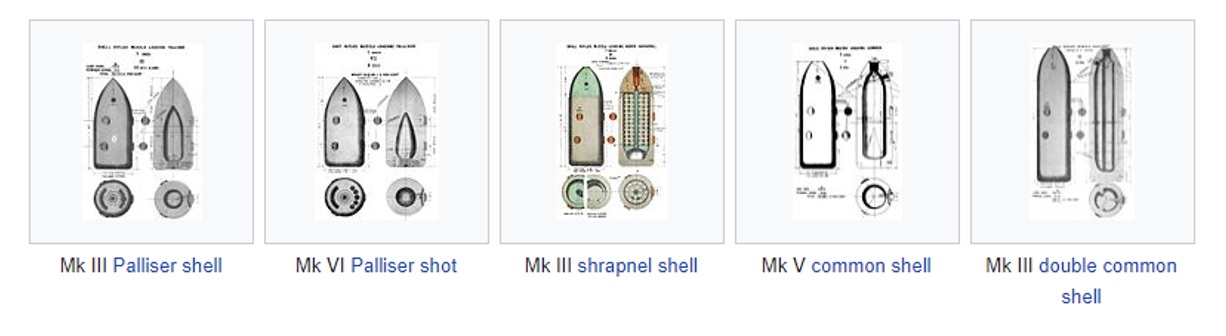
Rifled muzzle loader ammunition
These rifled muzzle loader guns were the first to incorporate the new “Woolwich” rifling system, a modification of the French system, of from 3 – 9 broad shallow grooves after Britain abandoned the Armstrong “shunt” rifling system in May 1865 : “…M.L. 7-inch guns in course of manufacture were rifled on this principle, upon which all of our heavy pieces since have been rifled. The 7-inch referred to, and introduced into the service in 1865, were the first of the so-called Woolwich guns, which then meant “wrought iron M.L. guns built up on Sir W. Armstrong’s principle, improved upon by hooking the coils over one another, and having solid ended steel barrels, rifled on the system shown above, for studded projectiles“.
All versions were constructed of a steel A tube surrounded by various numbers and thicknesses of wrought-iron coils. Rifling was 3 grooves with a uniform 1 turn in 35 calibres i.e. in 245 inches.
Coal expended 3 cwt. Number on sick list 9.