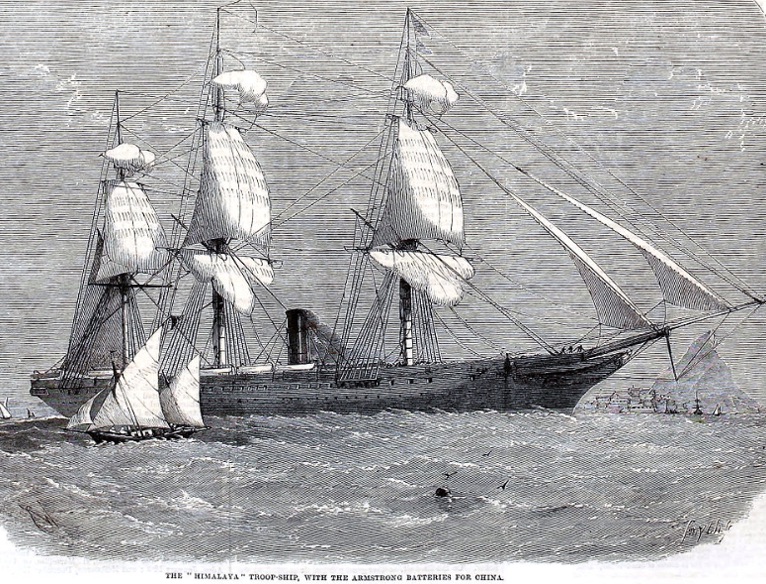
At sea Portland to Devonport. Course S84W at 8 knots. Wind west force 4 with overcast sky and fog. Barometer 30.15 inches rising to 30.20 at 0800 and to 30.31 at 2000 before finishing at 30.18 inches at midnight. Temperature at midday 49F. 0115. Start Point abeam at 5 ½ miles.0225. Altered course to N50W. 0515. Altered course N50E. Sounded in 14 fathoms. 0530. Altered course to N54E. Sounded in 13 fathoms. 0545. Altered course S10E. Sounded in 11 fathoms. 0600. Altered course S82E. Sounded in 9 fathoms. 0630. Course as requisite for Sound. 070. Stopped. Came to buoy and made fast. 0800. Saluted Commander in Chief. 1100. Slipped from buoy and proceeded up harbour. 1150. Stopped and made fast to HMS Himalaya. Received 306 lbs of beef and 153 lbs of vegetables.
https://en.wikipedia.org/wiki/HMS_Himalaya_(1854)
P&O had concluded that Himalaya was a larger vessel than the passenger traffic demanded and, with coal becoming more expensive with the advent of war in the Crimea, would not be economic. In July 1854, after another trooping voyage, to Scutari, the company was able to persuade the British Government to buy her to use as a troopship for £133,000, a little above her cost price of £130,000.
She retired from trooping service and was decommissioned on 28 September 1894.[21] Retained to become a coal hulk in the Hamoaze, Devonport, in December 1895, and with the new name C60, she was sent to Hull for conversion by Earle’s Shipbuilding Co to a vessel able to store 4,500 tons of coal.[12][18] She returned to Devonport at the end of June 1896.[22]
Noon. Wind SW force 3 with overcast sky. 1300. Tested life buoys – found correct. 1330 Commenced coaling. Received 47 tons. Received 10 tons of water. 1600. Wind SW force 1 with overcast sky. 1700. Received 53 tons of coal. 1850. Finished coaling. Received 80 tons. 1900. Employed cleaning ship. Special leave to both watches. Coal expended 7 tons 19 cwt. Number on sick list 1.