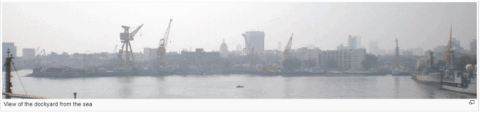
At a buoy off dockyard in Bombay. Wind calm to northerly force 1 with broken cloud. Barometer 29.86 inches falling to 29.85 inches at noon. Temperature at noon 83F. . 0700. Raised steam in number 2 boiler. Received 116 lbs of fresh beef and 50 lbs of vegetables plus 235 lbs of bread. 0400. Slipped and proceeded under steam to buoy of dock. 0600. Proceeded into Lower Duncan Dock. Engines as requisite. Let go and picked up Stream anchor. 0730. Ship shored up in dry dock. 1330 Let fires die out. Fire Stations. Sent one stoker to hospital 1630. Discharged Ship’s Company to Sailor’s Home. Coal expended 1 ton 10 cwt. Number on sick list 2
Lower Duncan Dry Dock Bombay (Mombasa)
In 1811 the British Royal Navy took over the Yard, continuing to work with the Wadia family as Master Shipwrights. There was much construction on the site around this time. Duncan Dock, which was the largest dry dock outside Europe at the time, was constructed in 1807–1810, and remains in use today.[4] The main Dockyard building, which fronts onto Shahid Bhagat Singh Road, dates from 1807, as does the administration block. The nearby Great Western Building (formerly Admiralty House) had housed the Port Admiral from around 1764–1792.
Today the Yard serves as the premier repair yard of the Indian Navy. It employs 10,000 workers (mostly civilians) overseen by an Admiral Superintendent.