Escorted Force H to Sardinia then onto the Balearic Islands 1941. COSSACK entered Alghero with MAORI and bombarded the waterfront destroying the Custom House and the seaplane base. Star shell ignited house inland.
The following is from Mauro Almaviva an Italian historian.
Punta del Giglio battery was involved in the only naval attack directed against the coastal defences at Alghero.
During the night of July 31st and August 1st1941, two British destroyers (Cossack and Maori) departing from a convoy headed to Malta (operation Style), heading for the coast.
According to documents of the British Government (1), the Cossack entered Alghero bay, fired flares that set a building on fire in the outskirts of the town, but she did not find any enemy’s ship.
The second destroyer, the Maori, entered the Porto Conte bay, started firing at the seaplane base and hit the slipway and buildings.
However, according to the testimony of seaman Kenneth Robinson, boarded on Cossack, this ship too fired with all guns in quick succession, for about fifteen minutes, firing at nothing in particular: «just making a lot of noise» (2)
The raid, moreover, paved the way for the air strike on the airport, that was carried out during the same night, and was aimed at raising the suspicion of a possible landing.
Actually, just the Maori, that fired about 30 shells within the space of 40 minutes, was spotted by the Italians and she was the object of the Army dispatches so confused that, in some of them, a submarine or a motor torpedo boat were assumed.
Nevertheless, in phone and telegraph dispatches sent by the Navy and Air Forces just after the raid, a «naval task-force» or «Enemy units» were mentioned.
In the war diary of the Artillery Command, on August 1st, it is reported that the enemy vessel (Maori) fired «some shots and flares» that reached the 43rd Battery (at Punta del Gallo).
However, there is no mention of that in the official records of the military inquiry.
One of those records, reports that the unit shot, at the beginning, about ten flares aimed at Alghero and Porto Conte, then while coming out of the bay, she switched on the searchlight pointing at the barracks of the Finance Police, firing disruptive and illuminating shells.
A direct testimony of this episode, by Dr Pietro Fiore, a citizen of Alghero at that time seventeen years old, is mentioned in almost two references.
Fiore and his brother, while sleeping in their room, heard a far rumble, they went to the beach and, when arrived there, they spotted blazes and more rumbles. They immediately realized they were gun shots starting from the sea just under Capo Caccia, not far away from Grotta Verde (Green Cave).
They were not able to realize who was shooting and where. After some time, they heard muffled noises above their heads followed by explosions between mount San Giuliano and the area called La Scaletta, sign that the enemy ship changed, probably her target.
They were forced to go back home by a Carabinieri marshal (3) who just arrived at the beach. Fiore, anyway, counted a few shots towards San Giuliano, but many more towards Porto Conte.
However, it is possible that, according to British reports, the shots passing over Fiore’s head, were also coming from the Cossack together with flares.
There was no armed response from the battery SR 413 of Punta del Giglio, from the 103rd (mount Murone) and 145th Guardia alla Frontiera (4).
Regarding the latter, it is a mystery that the guns servants did not spot the Cossack in Alghero bay.
Reconstruction of the attack by the Maori (shown as N) at Porto Conte on August 1st, 1941 (by permission of AUSSME (5))
An inquiry was launched on the lack of armed response, and during the hearing there were testimonials conflicting or changed over time.
Through the consultation of the documents stored at the Archives of the Historical Office of Army High Command, we have discovered that there were indecisions and failure to take responsibility.
At Punta del Giglio battery, the servants were ready, and the guns loaded, however the order to shoot never arrived.
Thus, there was mixing up of amnesias and conflicting testimonials: the battery did not shoot because the ship was into the dead angle (however getting out of the bay she would have been within the shooting range), no shooting for not revealing the battery location, no shooting because nobody sighted the ship or she was sighted but not identified, lastly she was identified as the Maori because the bow funnel was bigger.
The battery commander was put under arrest and, later, prosecuted; but, despite the evidences and the testimony of the gunners, he was acquitted because “he was not authorized to start firing by his superiors”.
According to one of the gunners, called to testify, the commander was quite protected in high places.
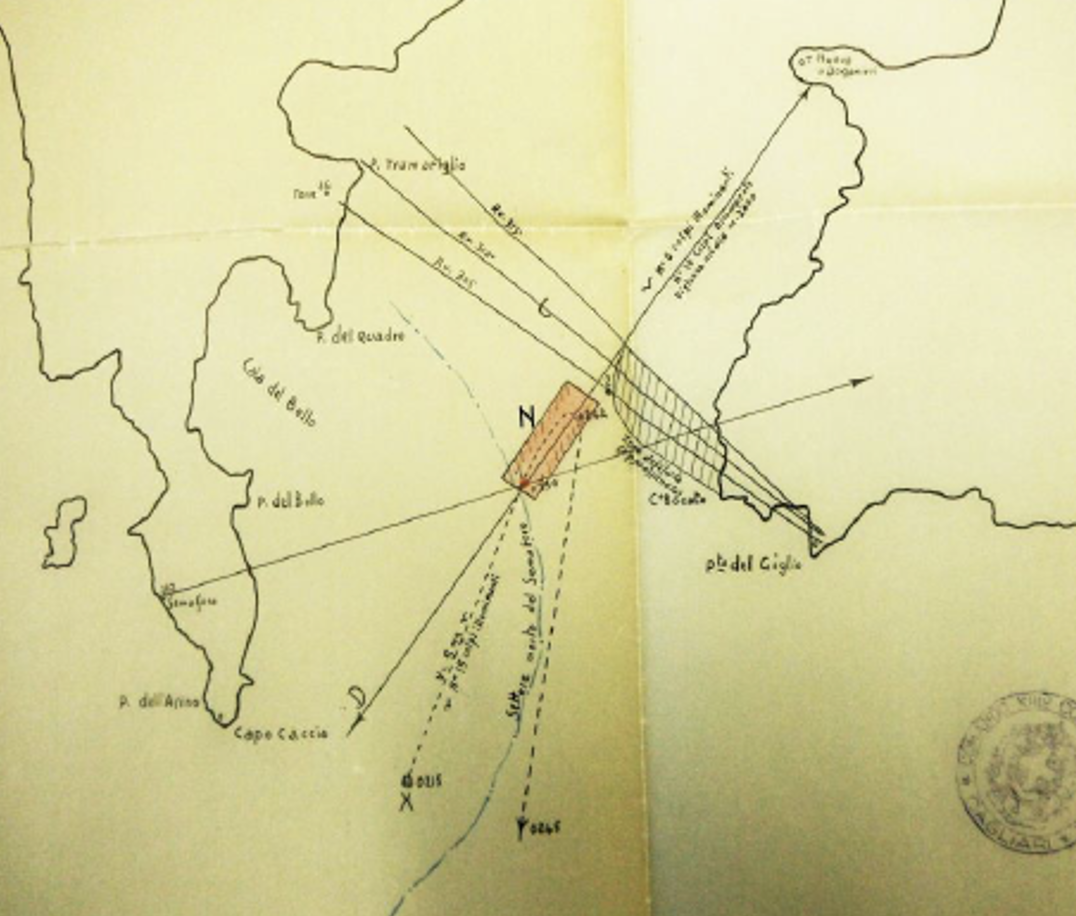
Reconstruction of the attack by the Maori (shown as N) at Porto Conte on August 1st, 1941 (by permission of AUSSME (5))
The 145th battery (positioned at Cantaro, south of Alghero) did not fire because two of the four guns were, since some time, out of order and they were the ones pointed towards Capo Caccia. The guns were afterwards replaced, in February 1942.
The commander was challenged for not having rotated one of the working guns to cover also that area.
About the 103rd battery (positioned on an esplanade between the mounts Murone, Vaccargiu and Doglia), where the commander arrived late in his command post, the justification for not firing was that the ship was out of range of the howitzers aimed at counteract a landing and not to shoot a ship. The distance was, nevertheless, assessed with binoculars and not with a range finder.
The 60 cm searchlight, of Torre Nuova at Porto Conte, was not turned on. Still, even if the switching on was not necessary since the Maori was easily spotted by the blazes of her guns and by her searchlight, the justification was that the orders were unclear.
However, just to dispel any doubts, on August 2nd 1941, general Mora issued a dispatch in which, among others, it was ordered «the immediate lighting of the searchlight by decision of the head of the station, in case of any type of alert».
In conclusion, an Italian-style mess where deficiencies in command lines, delays, lack of initiative and inaccuracy, led to the failure to react by our artilleries.
Who knows what the British seamen thought: probably they must have wondered why there was no reaction and, maybe, they had a few laughs about the inefficiency of the Italian Royal Army.
In any case it was not a great deed: about thirty shots fired with just the result of having forced the Finance Police to eat cold meal since the only damage was to the kitchen of their barracks in Porto Conte.
The Cossack hit twice the headlines. The first was in February 1940, when a few of her seamen boarded the German oil tanker Altmark, at anchor inside a Norwegian fjord, to free about 300 British prisoners detained in the tanker. Hitler took advantage of the episode to invade the Norway that was, then, neutral.
The second was in May 1941 when she took part, together with the Maori and other British warships, to the hunt and the following sinking of the German battleship Bismark.
The two British destroyers were, later, sank: the Cossack hit by a torpedo in October 1941 and the Maori hit by a bomb in Malta harbour in February 1942: tragic war Nemesis.
In book references
(1) Weekly Resumé n101 of 1941
(2) http://www.hmscossack.org/download/SOME%20SURVIVORS’%20NARRATIVES.doc
Notes not in the book but added for comprehension
(3) Carabinieri are an Italian Police Forces
(4) Guardia Alla Frontiera are Border Guard Corps
(5) It is the acronym for the Archives of the Historical Office of the High Command of the Italian Army
The SR 413 battery at Punta del Giglio was armed with 102/35 guns
The 145th battery was armed with 152/45 guns
The 103rd battery was armed with 149/12 howitzers
Reconstruction with today’s aerial and satellite photographs.
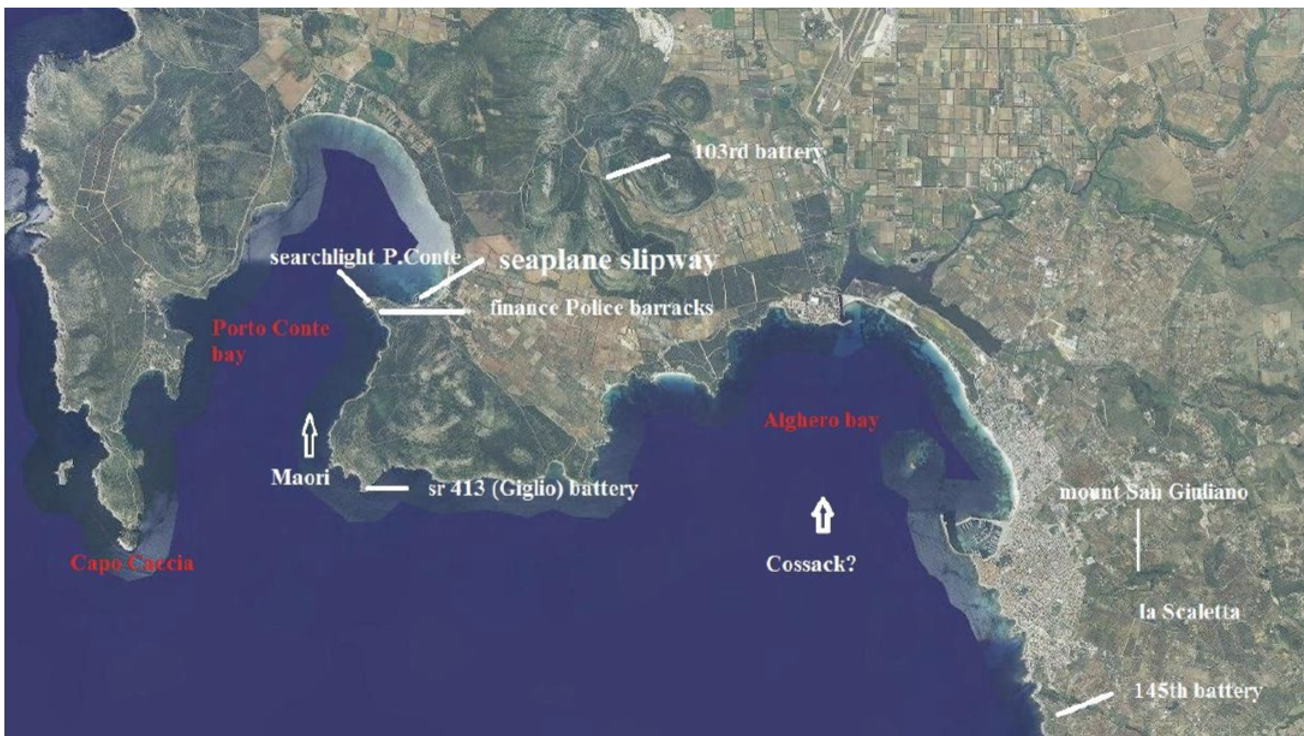
Reconstruction of the Cossack and Maori raid. Most likely it was the Cossack that hit mount San Giuliano and La Scaletta. (Sardinia Region, aerial and satellite photographs)
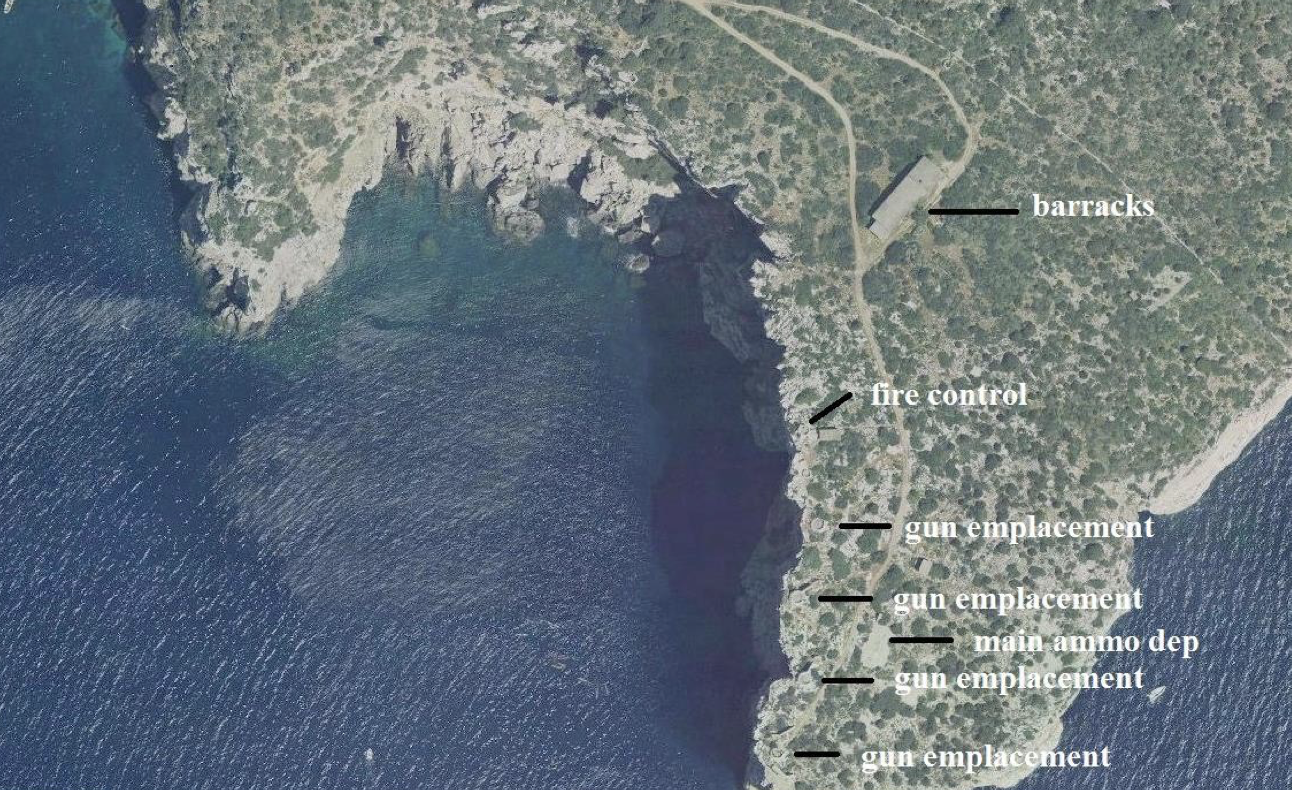
Sr 413 battery (Google Earth photograph)
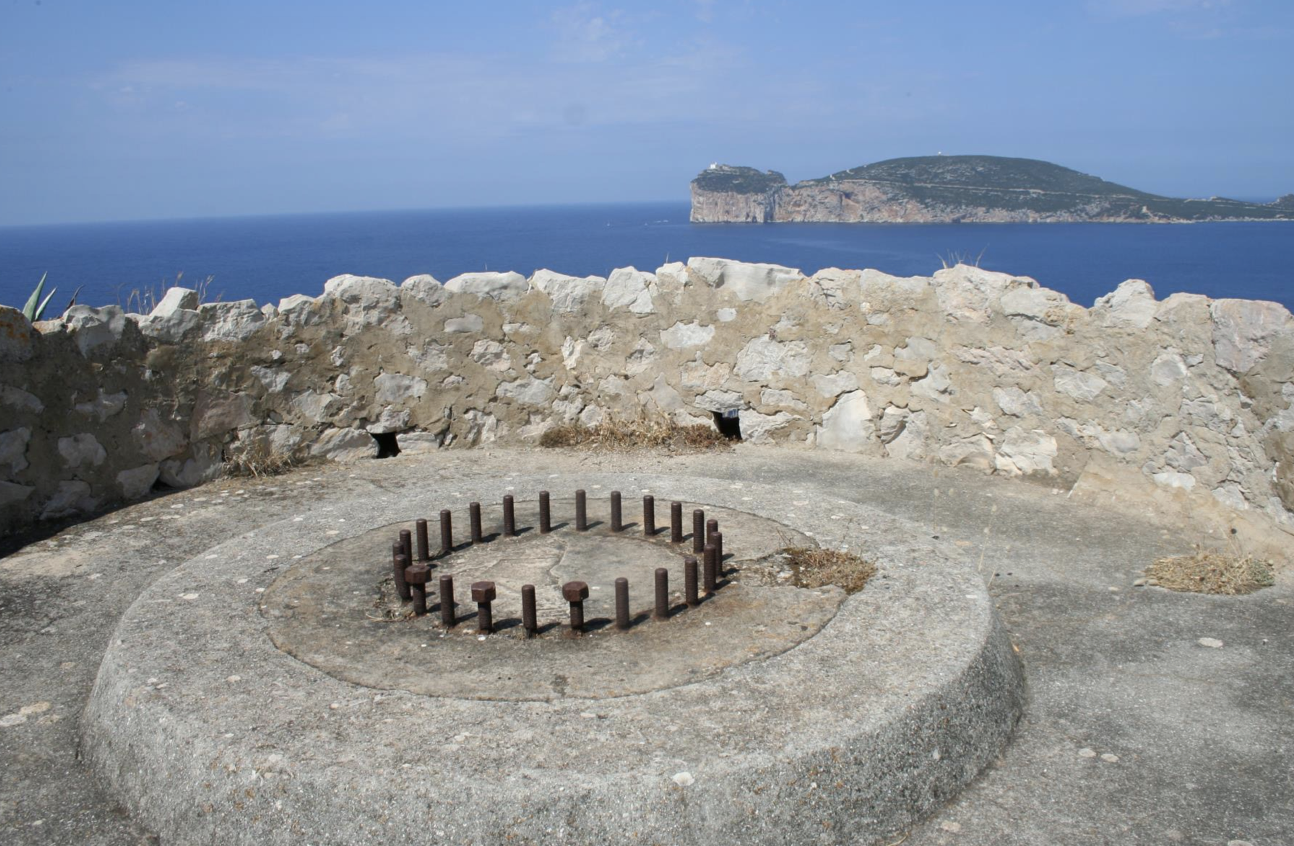
Sr 413 battery gun emplacement. On the background Capo Caccia, with the lighthouse. With the maximum range of 12km the 102/35 guns could have hit the Maori on her way back to the convoy, the battery had also its own searchlight.