Moored in Trincomalee Harbour. Wind N by E force 2 to 3 with broken cloud. Barometer 30.04 inches rising to 30.09 at noon before dropping to 30.03 at 1600 and finishing at 30.03 inches at midnight. Temperature at noon 90F. 0400. Raised steam in all boilers. 0600. Received 118 lbs of beef and 59 lbs of vegetables plus 225 lbs of bread. 0800. Bent fore and aft sails. 0900. Prepared for sea. 1000. Divisions and prayers. 1100. Divers cleaning ship’s bottom. Noon. Sick joined from Sick Quarters. Noon. Wind north force 2. Draught 14 feet 6 inches forward. 16 feet 2 inches aft. 1400. Unmoored and weighed stream anchor. Shortened to 1 ½ shackles port. 1545. Weighed. Proceeded as requisite out of harbour. 1610. Worked up to ¾ horsepower. 1630. Shaped N24E. Patent log put over side. 1645. Proceed at ¾ horsepower. Connected hand wheel. 1715. Proceeded at full speed. Over Harpoon log.
Walker’s Harpoon Ship Log
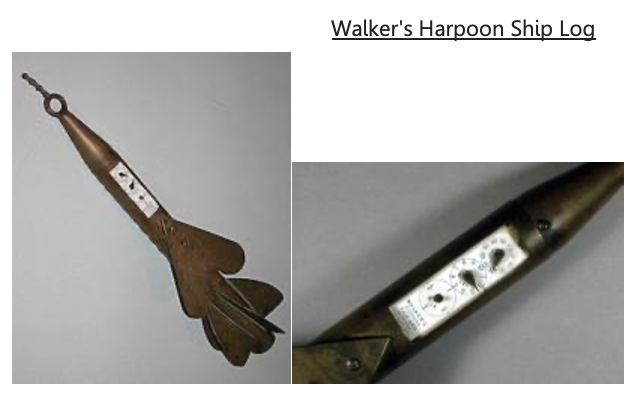
This mechanical log tells the distance the ship sails through the water by recording the number of times the five-finned section of the mechanism turns. The indicator shows nautical miles sailed, in hundreds, tens, and ones. The log was towed astern of the ship and hauled in for readings. Though not perfect, the harpoon log was significantly more accurate than the traditional chip log and sand glass. This instrument was patented September 18, 1866. Thomas Walker & Son was a British firm that patented their first log in 1861. They continued to develop and patent logs into the 1930s.
- Quarters. 2112. Finished full speed trial – 13.4 knots. Proceeded at ¾ horsepower. 2300. Exercised close watertight doors. Exercised sea bots crews. Coal expended 22 tons 6 cwt. Number on sick list. 8.