Year by Year
Discover the history of the HMS Cossack from 1938 to 1941.
You can search the ‘year’ and ‘month’ to find a specific date and also ‘click’ on the date itself to reveal any images and moments from that date.
22 March 1940
At daylight COSSACK and GURKHA joined 9 west coast ships from convoy HN21 en route from Bergen.
CONVOY HN 21 – Norway-U.K.
Departed Norway on March 22-1940 and arrived Methil on March 25
| Transcribed from Advance Sailing Telegram received from Tony Cooper, England – His source: Public Records Office, Kew. Convoy stations are not known. A document listing all the Norway-U.K. Convoys states that Convoy HN 21 had 7 British, 18 Norwegian, 5 Swedish, 4 Danish, 4 Finnish and 1 Estonian ship for a total of 39, 9 of which were bound for the west coast. | |||
| Ship | Nationality | Cargo | Destination |
| Lily | Danish | ballast | Port Talbot |
| Vestra | British | pig iron | Grangemouth |
| Eos | Estonian | general | Aberdeen |
| Garm | Swedish | fresh produce | Hull |
| Scania | “ | pulp – props | Blyth |
| Trolla | Norwegian | pulp | Grimsby |
| Kongshavn | “ | cod roe | illegible (looks like Concarneau) |
| Vard | “ | ballast | Blyth |
| Hjalmar Wessel | “ | ballast | Blyth |
| Sollund | “ | talc | Manchester |
| Lab | “ | pulp | Calais (did not sail? See note below) |
| Nurgis | “ | pulp | Dundee |
| Røsten | “ | pyrites | Hull |
| Burgos* | “ | general | London |
| Bjørkhaug | “ | pulp | Rouen |
| Vestmanrød | “ | fish roe | same as Kongshavn |
| Pluto | Finnish | ballast | Barry |
| Rosenborg | “ | pulp | Grimsby |
| Rigmor | Danish | ballast | Blyth |
| Karen | “ | ballast | Tyne |
| Sophie | “ | ballast | Methil |
| Galatea | Norwegian | general | Hull |
| Vestland | “ | ballast | Burntisland |
| Asgerd | “ | paper – timber | Hull |
| Roy | “ | ballast | Tees |
| Navarra | “ | ballast | Swansea |
| Diana | “ | general | Newcastle |
| Mira | “ | fresh fish – passengers – mail | Newcastle |
| Johanna | Swedish | general | Rouen |
| Gwalia | “ | general | Manchester |
| Maud Thordén | Finnish | timber | Liverpool |
| Hague | British | general | Grangemouth |
| King Alfred | “ | ore | Immingham |
| Bradburn | “ | ore | Middlesbrough |
| Grängesberg | Swedish | ore | Middlesbrough |
| Becheville | British | ore | Middlesbrough |
| Wentworth | “ | ore | Immingham |
| Sarmatia | Finnish | pulp | Rochester |
| Erica | Norwegian | pulp | Manchester |
| Fintra | British | general | Grangemouth |
| The above agrees on the whole with a list of ships received from Don Kindell, based on the late Arnold Hague’s database, except A. Hague has not included the Norwegian Lab in this convoy. Note that she also appears in HN 23B. | |||
| * According to my info for Burgos, she struck a mine on March 28 before having reached her destination – see my page about this ship. The external site that I’ve linked to further down on this page (scroll down in the text under March 28) states she was in Convoy FS 31 at the time, and that the sloop Pelican rescued her entire crew. The FS convoys are available on this external site and Burgos is included on this page. As will be seen, the Norwegian Asgerd, Trolla and Bjørkhaug, the Swedish Johanna, the Finnish Rosenborg and Sarmatia, and the British King Alfredand Wentworth (all from Convoy HN 21) are also listed. All the Norwegian ships mentioned here are discussed on this website, some are listed in the Homefleet section. The easiest way to find them all is via the Master Ship Index. Report on passage is not available. Escorts mentioned on this page: |
25 March 1940
COSSACK departed Scapa Flow at 0700 in company with ESKIMO and PUNJABI to search area 61N to 60 N, 2W to 4W
U.47 at 0600 sank Danish steamer BRITTA (1146grt) in 60‑00N, 04‑19W, off Sule Skerry. Five survivors were picked up by Danish steamer NANCY (1153grt) which was in company, but thirteen crew went missing.
Destroyers ELECTRA and ENCOUNTER, returning to Scapa Flow, proceeded to the location and ELECTRA stood by the rescue area. At 1241, ELECTRA and ENCOUNTER were ordered to return to Scapa Flow where they arrived at 1830. Destroyers HOTSPUR and HERO from Sullom Voe and SOMALI, MATABELE, FAME, FORESIGHT, SIKH, FOXHOUND from anti-submarine operations east of the Orkneys were sent to the area. Destroyers COSSACK (D.4), ESKIMO, PUNJABI departed Scapa Flow at 0700. The wreckage of BRITTA was later found eighteen miles from the reported position.
In anti-submarine operations on 25 and 26 March, COSSACK, SIKH, FOXHOUND, HOTSPUR, HERO were searching in the area 61N to 60N, 2W to 4W. They were joined by destroyer NUBIAN after escorting submarine TRIBUNE and destroyer FIREDRAKE after repairs from destroyer depot ship WOOLWICH. Destroyer FIREDRAKE was then ordered to join destroyers ICARUS and IVANHOE and the anti-submarine trawlers on the Moray Firth patrol. In anti-submarine operations on 25 and 26 March, destroyers SOMALI (D.6), ESKIMO, PUNJABI searched the eastern half of a patrol area from 60N to 59N, 3W to 5W. MATABELE, FAME, FORESIGHT searched the western half of this area.
31 March 1940
COSSACK departed Scapa Flow at 0540 to join the convoy escort to HN23 from Bergen. En route stands by the disabled trawler SOPHOS (217 tons) from 1130 to 1415 when another trawler arrived to take her in tow.
CONVOY HN 23A – Norway-U.K.
Departed Norway on March 30-1940 and arrived Methil on Apr. 3
| Transcribed from Advance Sailing Telegram received from Tony Cooper, England – His source: Public Records Office, Kew. Convoy stations are not known. The Advance Sailing Telegram, consisting of 4 pages, contains ships in the 2 convoys HN 23A and HN 23B all together, and I’ve extracted the HN 23B ships and placed them on a separate page (see HN 23B). Please note also that the Advance Sailing Telegram for the previous convoy appears to cover both Convoys HN 22 and HN 23A, so that some ships have been extracted from those documents and placed here on this page. (W= the ship was bound for the west coast, according to the AST). A document listing all the Norway-U.K. Convoys states that Convoy HN 23A had 1 British, 12 Norwegian, 7 Swedish, 6 Danish, 8 Finnish, 4 Estonian and 1 Latvian ship, for a total of 39, 14 of which were bound for the west coast. | |||
| Ship | Nationality | Cargo | Destination |
| Tobago | Latvian | pulp W | Watchet |
| Helios | Estonian | ballast | Sunderland |
| Magne | Swedish | general | Hull |
| Kemi | Finnish | pulp W | Ellesmere Port |
| Signe | “ | ballast | Burntisland Sunk – See Notes |
| Jussi H | “ | general | Hull |
| Gottfrid | “ | ballast | Blyth |
| Skagen | Danish | ballast | Tyne |
| Note that Skagen is mentioned in Bedouin‘s report for Convoy HN 23B, said to have been in station 17 of that convoy. | |||
| Alf | “ | ballast | Methil |
| Ulrik Holm | “ | ballast | Blyth |
| Bjørnvik | Norwegian | pulp | London |
| Bro | “ | fish W | Bordeaux |
| Esbjørn | Finnish | general | Leith |
| Merkur | Estonian | ballast | Blyth |
| Viiu | “ | ballast | Hull |
| Frisia | Swedish | general | London |
| Gun | Norwegian | ballast | Tyne |
| Dagmar | Danish | ballast | Glasgow |
| Elgö | Swedish | general | Hull |
| Aina | Estonian | pulp W | Ellesmere Port (for info, also listed in HN 25) |
| Thore Hafte | Norwegian | manganese | Middlesbrough |
| Emily | Finnish | ballast | Tyne |
| Spica | Norwegian | fresh fish – mail | Newcastle |
| Birgitta | Swedish | pulp | Rouen |
| Freidig | Norwegian | pulp W | Rouen? |
| Alfa | Swedish | pulp W | Preston |
| Illegible (looks like Edle) | Norwegian | carbide W | illegible (Runcorn?) |
| Barrwhin | British | ore W | Manchester Returned? |
| Barrwhin is also listed HN 24. The following ships have been extracted from the Advance Sailing Telegram for Convoy HN 22, which appears to contain ships for HN 23A as well. A list of ships received from D. Kindell, based on the late Arnold Hague’s database, also has these ships in Convoy HN 23A. | |||
| Akabahra | Norwegian | ballast | Tyne |
| Brask | “ | ore | Workington |
| Brisk | “ | general | London |
| Elizabeth | Danish | ballast | Tyne |
| Ergo | Finnish | ballast | Blyth |
| Frode | Norwegian | ballast | Tyne |
| Neva | Swedish | pulp W | Preston |
| Norruna | “ | general W | Belfast |
| Regin | Norwegian | general | Hull (Commodore Vessel) |
| Robert | Danish | ballast | Tyne |
| Tauri | Finnish | ballast W | Barry Roads |
| Several of the ships named in this table are also listed in the last convoy from Norway, HN 25. | |||
| Notes: All the Norwegian ships mentioned here are discussed on this website, some are listed in the Homefleet section. The easiest way to find them all is via the Master Ship Index. In the evening of Apr. 1, the Finnish Signe stopped her engines, and HMS Gurkhawas sent to enquire if she needed assistance, but no reply was received. After a while Signe continued on the proper course, Gurkha remaining in company for 20 minutes, still signalling but getting no reply, so she resumed her station and informed Afridi that the Finnish ship had proceeded and was following in the wake of the convoy, about 5 miles astern. At 23:15 HMS Sikh heard an explosion which she thought might be from Cossack. She called her by V/S and W/T but, receiving no reply, she turned back to investigate, reporting her action to Afridi, but found nothing. Afridi then called Cossack on power, asking if she had anything to communicate, but she did not. The convoy consisted of 19 ships that evening (Apr. 1) and they were all still present the following morning. As it turned out, the Finnish Signe was sunk. Date of loss is given as Apr. 2, at 00:21, German time – Jürgen Rohwer suggests in his “Axis Submarine Successes of World War Two” that this ship was torpedoed and sunk by U-38 in area AN 1814. In a footnote he adds: “U-38 attacked a ship at the end of a convoy and observed a dense cloud of smoke and vapour. Area AN 1814 was east of Moray Firth and not in a direct line from Bergen to Burntisland” (Signe‘s destination). Uboat.net’s page about this attack has more info (external link). HMS Afridi‘s report (4th Destroyer Flotilla): During the night a full southerly gale developed, causing the ships to scatter by as much as 30 miles in the morning, and the convoy consequently never formed up. During the evening (March 31) their approximate positions were established, and the next morning, Apr. 1, 23 ships were gathered up, the gale having abated. 4 of them were westbound and were detached with HMS Mohawk and Encounter in order to pass north of the Shetlands. Mohawk also received orders to intercept and attach 7 more ships that had been reported by aircraft to be 15 miles to the northward, and therefore presumed to be westbound. Later in the day a northeasterly gale blew up, and the course steered became very erratic, with the wind and sea on the quarter. The starboard columns seemed to have gone about 15° to the westward of the course ordered and were prevented from grounding on Fair Island at about 00:30 by use of the emergency signal. Afridi was slightly to the west of her allotted course, but by this time it had become evident that the following units were likely to be met between 03:30 and 04:30 that morning, Apr. 2: * It looks like the B in HN 23B has been replaced by 23A here – the B has not been crossed out, but it’s underlined, and an A is written by hand next to it. In other words, it might have been one of the destroyers from HN 23A that passed through ON 24, while another nearly collided with HMS Glasgow. When off Kinnaird Head in the afternoon of Apr. 2 a Junker carried out an abortive attack* on the convoy, the weather being clear at that time. That same day, a 20th ship was seen and added to the convoy; this ship is not named. During the night, the wind shifted to the south and the weather became thick again. The Commodore Vessel, Regin, steered an incorrect course, reducing speed by about 4 knots, and for this reason Afridi‘s commander “applied, without further notice, for an extension of Bell Rock Light, its position being uncertain on account of the failure of the log and D/F in Afridi. It was eventually made, unlit, ahead, in time to alter course”. *A document about Convoys attacked by aircraft states that in the afternoon of Apr 2-1940, 3 convoys were attacked almost simultaneously as follows: 1 aircraft bombed the eastern portion of HN 23A at 14:57, 18 miles north of Kinnaird Head. Fighters were sent in support. HN 23A arrived in Largs Bay at 11:40 on Apr. 3. Speed made good: 5.3 knots. Afridi‘s commander mentions that the convoy guide, Regin “proved unable to steer a course, nor to maintain her speed except in calm”. Escorts mentioned on this page: Convoy HN.23 A of one British, twelve Norwegian, seven Swedish, six Danish, eight Finnish, one Latvian, four Estonian ships departed Bergen escorted by destroyers GURKHA, AFRIDI, SIKH. Antiaircraft cruiser CALCUTTA accompanied the convoy for anti-aircraft protection. Destroyer COSSACK departed Scapa Flow on the 31st at 0540 to join the convoy escort. En route, she stood by the disabled trawler SOPHOS (217grt) from 1130 to 1415 until another trawler arrived to take her in tow. At 0021/2 April, U.38 attacked the convoy, but was driven off by COSSACK. Destroyers ENCOUNTER and MOHAWK escorted 14 ships of the west coast section of the convoy. ENCOUNTER arrived at Scapa Flow at 0420 on 3 April and MOHAWK was detached in the evening of 2 April for an anti-submarine hunt. The 26 ships of convoy arrived at Methil at 0900 on 3 April, escorted by AFRIDI, SIKH, GURKHA, COSSACK, after being divided in heavy weather.
|
14 April 1940
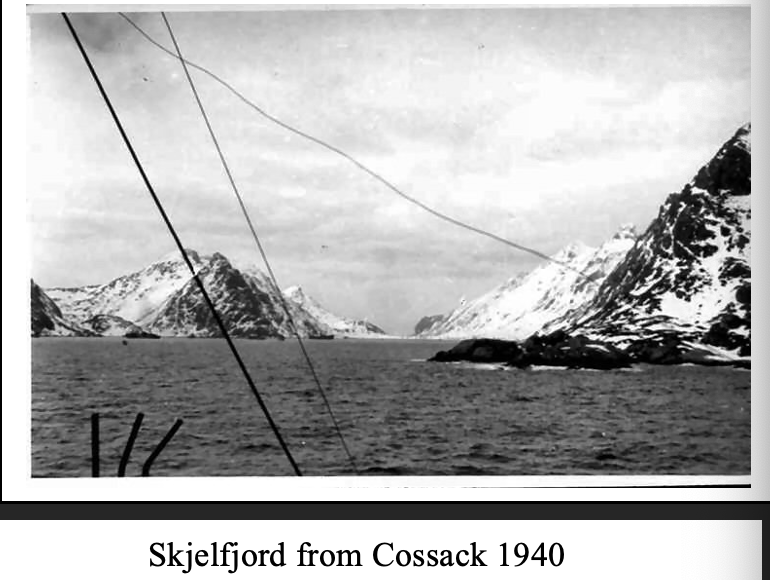
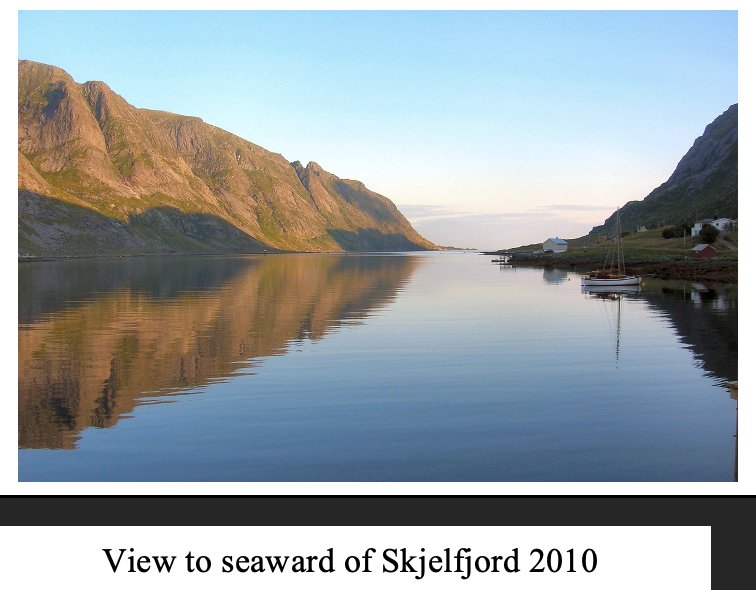
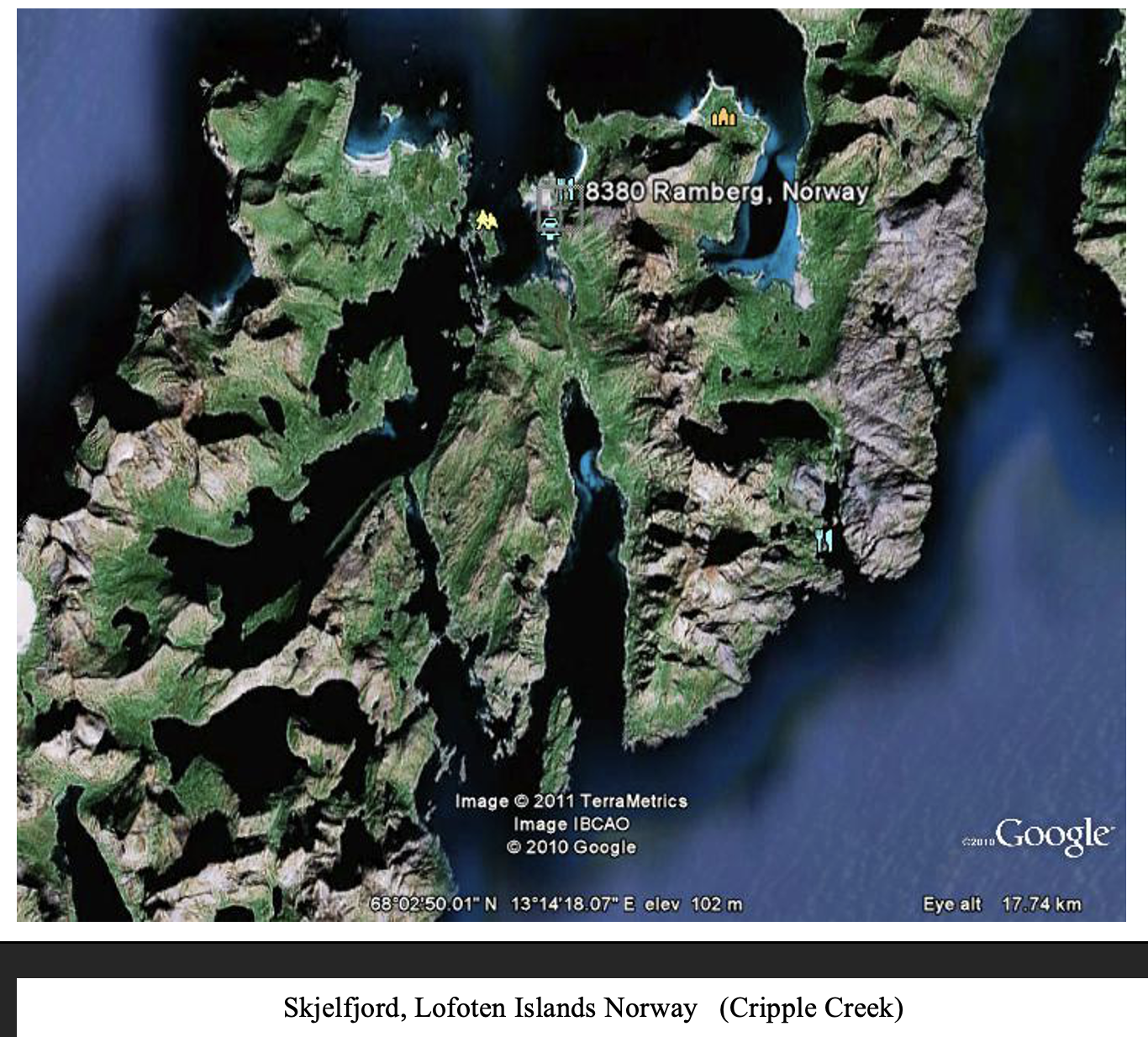
0315 Ship refloated on rising tide COSSACK proceeded to WARSPITE to offload casualties then with FORESTER / KIMBERLEY escorting preceded stern first to Skelfjorden. (Entrance to Skjelfjord) According to Kenneth Rail (Boy Seaman) those killed were transferred to WARSPITE for burial at sea.
HMS Cossack arrives at 1645 with escort HMS Forester. 68° 00’N 13° 15’ E. Cossack transferred her ammunition to HMS Zulu and her torpedoes to HMS Bedouin.
First Allied troops – British 24th Brigade under Brig. Fraser landat Harstad in Norway to assist Norwegian 6th division under Maj Gen Fleischer
16 April 1940. Skjelfjord. (Cripple Creek) Under temporary repair with the help of local Norwegian engineers. Ammunition transferred to ZULU and torpedoes to BEDOUIN.
COSSACK held a thank you tea party for the local children and gave the locals Corned beef and biscuits
Before COSSACK, HOTSPUR and PUNJABI sailed the Captain of ESKIMO obtained from them 6 shackles of different sized cable and one anchor and ordered BRIGAND to lay it out with the ends buoyed in a corner of the fjord. This was used during bad weather or when there was no ship to secure to. A stockless anchor with a length of cable has been found in Skjelfjord during Spring 2014. Divers are hoping to recover and clean it so its source can be identified.
23 April 1940
Departs Skjelfjord at 2300 with tanker WAR PINDARI. (HF WD, HF D WD and movement books refer) Bad weather meant a continuos bucket chain was necessary to prevent serious flooding. Eight officers from ALSTER were onboard.
Other ships visiting the fjord were
BEDOUIN, BRITISH LADY, ESKIMO, FORESTER, HAVOCK?, HOSTILE, HOTSPUR, IVANHOE, JUPITER, MATABELE, PENELOPE, PUNJABI, ZULU, SS ALSTER, ORP BLYSKAWICA,WAR PINDARI.
Some sources say the empty tanker was BRITISH LADY who left on 20 April escorted by PUNJABI and HOTSPUR.