Year by Year
Discover the history of the HMS Cossack from 1938 to 1941.
You can search the ‘year’ and ‘month’ to find a specific date and also ‘click’ on the date itself to reveal any images and moments from that date.
14 July 1941
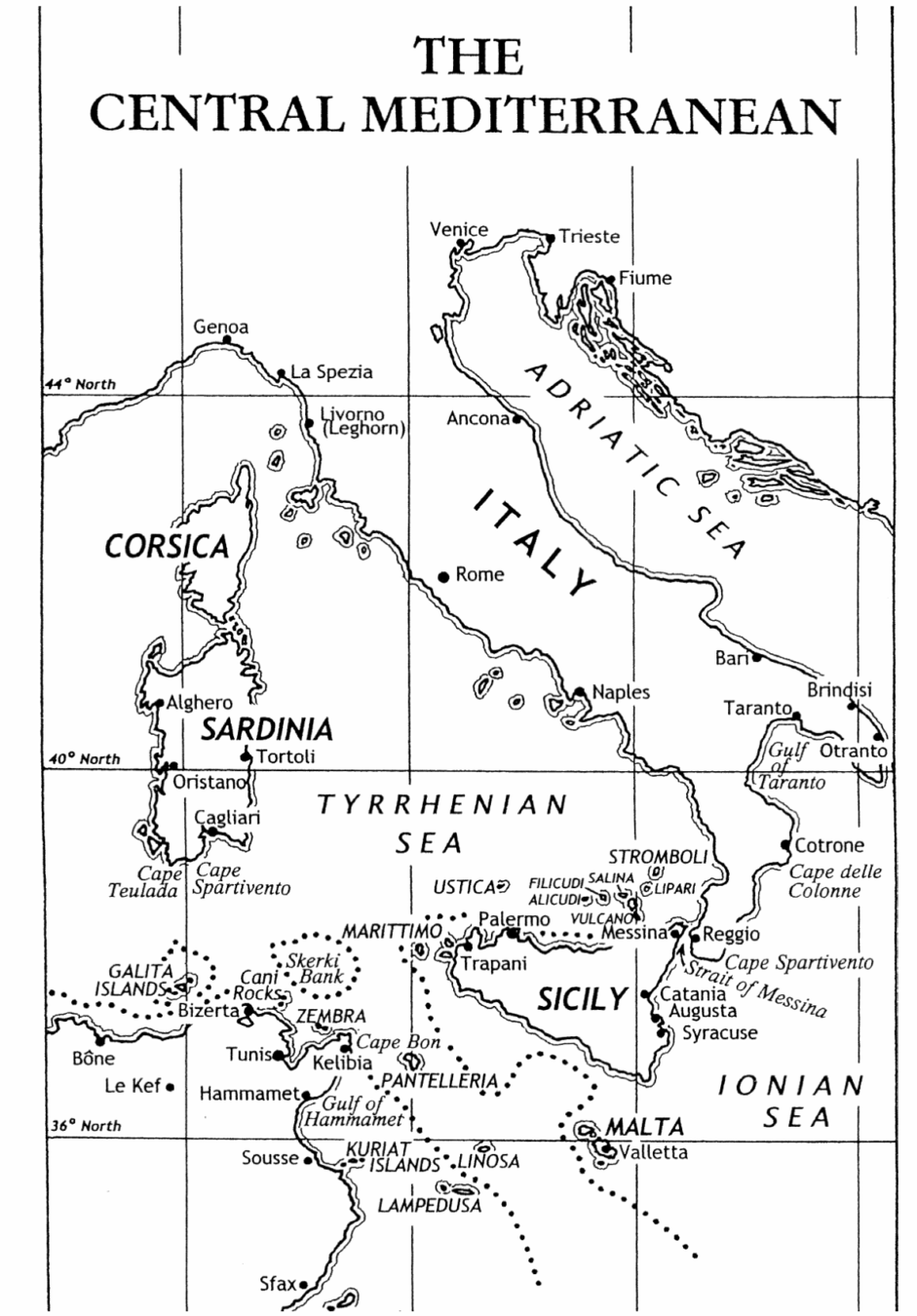
Gibraltar – Operation Substance –
(Extract from The Naval War in the Mediterranean 1940 -1943 ISBN 978-1-84832-618-7) Included two anti-aircraft regiments (One light and one Heavy) and thirty field guns to strengthen Malta against possible airborne attack
Force H
RENOWN, ARK ROYAL (21 Fulmers and 7 Swordfish as reinforcements for Malta)). Destroyers -HERMIONE, FAULKNOR, FEARLESS, FOXHOUND, FIREDRAKE, FORESIGHT, FURY, FORESTER, DUNCAN
Home Fleet – part of which formed Force X
NELSON, MANXMAN (Fast minelayer), EDINBURGH, MANCHESTER, ARETHUSA, Fleet Destroyers – COSSACK, MAORI. SIKH, LIGHNING, HMAS NESTOR (Joined at Gibraltar). Hunt Class -FARNDALE, AVONDALE, ERIDGE.
Merchant fleet
AVILA STAR (Detached before Gibraltar), CITY OF PRETORIA, DEUCALION, DURHAM, LEINSTER (Ran aground off Carnero Point), MELBOURNE STAR, PASTEUR (Failed to join convoy), PORT CHALMERS, SYDNEY STAR
23 July 1941
COSSACK joined Force X. Speed of convoy 13.5 knots with a mean course of due East.
Main convoy located by the Italians and was attacked by nine S.79 torpedo bombers at low level while five Cant Z1007 bombed from high altitude. ARK ROYAL launched seven Fulmars to join the four already airborne but three were lost to enemy fire.
As part of Force H. MANCHESTER attacked by torpedoes launched by MAS numbers 16 and 22. Damaged by aerial torpedo from a S.79 (which was shot down ) hitting an oil fuel tank. 26 killed and one wounded.
Aerial attack at 0910 (0945?) by SM79 bombers.
FEARLESS hit by an aerial torpedo from a S.79) North of Bone. She was sunk at 1055 (37-40N, 8-20E ) by a torpedo from FORESTER after picking up survivors. 18 missing and 23 wounded of whom 9 died later.
Second aerial attack at 1011 by five Fiat BR20s at 17000 feet. They were attacked by five Fulmars
1900 Skerki Channel. Convoy attacked by four torpedo bombers from the South. One enemy shot down.
1945 High – level bombing of the convoy
FIREDRAKE damaged by near miss bomb. (Towed for 37 hours en route to Gibraltar.)
COSSACK ordered into the van of the Port column
Attacked off Cape Bon by aircraft and by two MAS boats who fired two torpedoes. Two torpedoes missed COSSACK who damaged two E-boats with gunfire.
24 July 1941
0013 Convoy turned SSE into the Italian convoy route.
0246 COSSACK’s radar picked up three small unidentified objects
0250 Short flashes of light were seen and motorboat engines were heard to start up. COSSACK lit up an Italian motorboat (MAS-boat) in her searchlight
COSSACK engaged Italian motor torpedo boats. A torpedo passed close astern
0300 SYDNEY STAR torpedoed and damaged in the bows.
0305 Noise of MAS-boat heard on COSSACK’s sonar. Captain Berthon orders immediate increase of speed intending to ram the boat close under the port bow. The craft fired a torpedo that passed under COSSACK’s bow. COSSACK opened fire but extent of damage to enemy boats not certain. (Records show MAS 532 and 533 were lost) Some sources claim these boats were undamaged
Sounds of MAS-boat engines heard for the next twenty minutes
(See page 83 -‘Red Duster, White Ensign’- Ian Cameron. One E-boat rammed by Cossack)
Entered Grand Harbour Malta at 1530 with MAORI, SIKH, FOXHOUND and FARNDALE. DECUALION, followed by PORT CHALMERS, CITY OF PRETORIA, MELBOURNE STAR, and DURHAM.
SYDNEY STAR, HMAS NESTOR and HERMIONE arrived independently having used the northern route.
COSSACK left three hours later having refuelled.
Extract from War Weekly 5 August 1941.
On the morning of 22 July an important convoy was being escorted through the central Mediterranean by British naval forces under the command of Vice Admiral Sir James Somerville when it was sighted by enemy reconnaissance aircraft. That night an Italian submarine delivered an attack. This was unsuccessful and it is possible the enemy submarine was destroyed by the very strong counter-attack top which it was subjected.
Next morning the first of a series of air attacks developed. This was by torpedo carrying aircraft synchronised with high level bombing. Of the six torpedo carrying aircraft which pressed home their attacks, three were shot down by our anti-aircraft fire. HMS Fearless, a destroyer of 1,375 tons launched in 1934 was hit by a torpedo, and had to be sunk by our forces. Her casualties were not many.
The high level bombing attack was completely unsuccessful, two of the enemy bombers being shot down by out naval aircraft, and two others probably destroyed. Three of our aircraft were lost in this engagement, but the crews of all of them saved.
During the afternoon further attacks by bombers and torpedo carrying aircraft developed. These attacks were abortive, and two S79s were shot down by our fighters and another enemy aircraft was damaged. In the evening our ships were again unsuccessfully attacked by similar methods. At this period the convoy was close to enemy bases but it eluded the air attacks by determination and skilful handling. Enemy aircraft were seen to be searching unsuccessfully for our ships with the aid of a large number of flares. Early on 24 July the convoy and its escort were attacked by enemy motor torpedo boats. During this attack one ship of the convoy received damage, but was able to continue under her own power. One of the attacking boats was certainly sunk, another probably damaged.
Three separate air attacks then developed on the convoy and its escort between 6.30 and 10 am. The third of these attacks was delivered by German dive-bombers at the same time that our ships were being subjected to high level bombing. In none of these engagements were any of our ships hit, but one of the German dive-bombers was shot down by our anti-aircraft fire. Enemy air attacks were also made on the fleet but no damage or casualties were suffered by any of our ships. Shortly before the development of the most serious of these last attacks, two Italian aircraft, both Cants, were shot down by our fighters. The main attack was delivered by torpedo carrying aircraft and high level bombers, but was broken up by our fighters. Two S 79s were brought down, and one was damaged in the course of the fighting. Three of our naval aircraft were lost but the crew of one was saved. During these operations one of our cruisers and one destroyer suffered some damage, there being a small number of casualties in each ship. Beyond the attack by motor torpedo boats already mentioned, no attempt was made by enemy surface forces to interfere, although this important convoy had, of necessity, to be for some time in close proximity to the enemy’s main bases. Italian and German air forces were unable to prevent this difficult operation being brought to a successful conclusion, and the long series of air attacks resulted in the destruction of at least 12 enemy aircraft with at least four others damaged and probably destroyed.
A special Press Correspondent who was onboard one of our cruisers gave a vivid account of his experience in what he described as “the most brilliant convoy action fought by the Navy in this war”.
“For 27 hours on end we were subjected to continuous attacks from the air and from motor torpedo bots as we, with another cruiser and destroyers, convoyed merchantmen through the Mediterranean. All of them arrived safely at their destination, obeying Admiral Somerville’s signal “Convoy must go through”.
“Fighters from HMS Ark Royal – which, with the RENOWN was with us from the first day, July 23 – took off to engage Italian aircraft soon after breakfast. We hear their battle cry “Tally Ho” over the wireless as they engage the enemy on the skyline. Terrific engagements are being fought over there as the aircraft swoop and soar with the rattle of machine guns. Twenty minutes later we hear the boom of the destroyer’s guns as they open fire against the enemy formation ahead. A column of black smoke goes up from the FEARLESS as she is hit. At the same moment the look-out shouts: ‘Italian plane hit.’ I see the aeroplane sweep down to the water and two Italians climb into a rubber boat. Another aeroplane has its wings plucked off and falls like a stone into the sea.
There is a brief pause in the din. At the microphone the Commander announces: ‘Two planes shot down and one destroyer hit’ so that the crew below decks may know what is going on! We are delighted because we believe we got one of the aeroplanes.
The two Italians in the in the rubber boat drift through the lines of ships. The second wave of Italians cannot face the terrific barrage we are putting up: they drop a hail of bombs harmlessly into the water a few miles away and flee pursued by the fighters from the Ark Royal.
Far astern the FEARLESS, now almost enveloped in smoke, blows up as she is torpedoed by another destroyer after the survivors have been rescued. We can not stop to assist her because the convoy must get through whatever happens. More of the ARK ROYALs fighters take-off in the smoke of the battle as enemy formations are reported.
We eat supper of soup and sandwiches at action stations which nobody left for two days and nights. At 7 pm torpedo bombers attack from starboard. Through glasses I see them skimming the water towards us like birds, shells bursting around them and pom-poms shooting a hail of fire into them. I see the torpedoes plop into the water as they swing away after the attack, one appearing to be hit. At 7.45another big formation attacks and more bombs fall erecting soundless columns of spray around us. The Italians flee before the withering barrage which shatters the tea cups on the bridge and spills tea on the navigating officer’s charts. Two Italians are shot down. Empty shell cases fill the wash places and over flow into the crew’s recreation space.
There was a lull until 3 am the next day, when Italian motor torpedo boats – which they call Motoscafi antisommergibile, or anti-submarine motor launches – make an attack. In the inky blackness the cruisers open fire at dim targets, pom-poms spouting across the sea like fireworks. There is a terrific excitement as the look-outs, with their eyes glued to their glasses, scan the sea.
Suddenly a flood of light appears ahead as a cruiser boldly switches her searchlight on for half a minute and I see an enemy boat scudding through the water to escape the shells. She twists and turns to escape the shows of metal hurled from the guns but the flying woodwork seen by the look-out means a direct hit.
Ten minutes later there is an explosion astern as a merchantman is torpedoed but she carries on and we and a destroyer are despatched to assist her.
At 7.20 pm eight Junkers 87 dive bombers come screaming to the attack. ‘Here they come again. Look out, here come the bombs; one hitting the sea 40 yards from us raises a water spout 60 feet high. The merchantman is plodding along near us with a heavy list and swings away just in time as a bomb drops almost beside her.’
Our guns are still firing and the air is filled with the stench of cordite as the black puffs rising skyward like tiny clouds near the Germans show that our gunners are well on the target. Two of the attackers are brought down. Altogether we were at action stations 60 hours, sleepless, red eyed and unshaven.
On 2 August 1941 the Italian Stefani News Agency reported that the Italians had sunk six steamers including a tanker – 10 to 15 thousand gross tonnage. The destroyer FEARLESS was hit by an aerial torpedo and finally had to be sunk by British units.
25 July 1941 Rejoined Force H off Galita Islands.
27 July 1941 Gibraltar
30 July 1941 Left Gibraltar with ARK ROYAL, ENCOUNTER, ERIDGE, FAULKNOR, FORESIGHT, FORESTOER, FOXHOUND, FURY, MAORI, NELSON, NESTOR, and RENOWN to create a diversion for Operation STYLE
(Another source quotes ARETHUSA, EDRIDGE HERMION and MANXMAN.)
(Operation STYLE – Force X consisted of ARETHUSA, HERMIONE, LIGHTNING, MANXMAN and SIKH departed Gibraltar for MALTA 31 July carrying troops and supplies that had been on the MANCHESTER and LEINSTER)
(Force S consisted of the oiler BROWN RANGER and the destroyer AVONDALE)
31 July 1941
Escorted Force H to Sardinia then onto the Balearic Islands 1941. COSSACK entered Alghero with MAORI and bombarded the waterfront destroying the Custom House and the seaplane base. Star shell ignited house inland.
The following is from Mauro Almaviva an Italian historian.
Punta del Giglio battery was involved in the only naval attack directed against the coastal defences at Alghero.
During the night of July 31st and August 1st1941, two British destroyers (Cossack and Maori) departing from a convoy headed to Malta (operation Style), heading for the coast.
According to documents of the British Government (1), the Cossack entered Alghero bay, fired flares that set a building on fire in the outskirts of the town, but she did not find any enemy’s ship.
The second destroyer, the Maori, entered the Porto Conte bay, started firing at the seaplane base and hit the slipway and buildings.
However, according to the testimony of seaman Kenneth Robinson, boarded on Cossack, this ship too fired with all guns in quick succession, for about fifteen minutes, firing at nothing in particular: «just making a lot of noise» (2)
The raid, moreover, paved the way for the air strike on the airport, that was carried out during the same night, and was aimed at raising the suspicion of a possible landing.
Actually, just the Maori, that fired about 30 shells within the space of 40 minutes, was spotted by the Italians and she was the object of the Army dispatches so confused that, in some of them, a submarine or a motor torpedo boat were assumed.
Nevertheless, in phone and telegraph dispatches sent by the Navy and Air Forces just after the raid, a «naval task-force» or «Enemy units» were mentioned.
In the war diary of the Artillery Command, on August 1st, it is reported that the enemy vessel (Maori) fired «some shots and flares» that reached the 43rd Battery (at Punta del Gallo).
However, there is no mention of that in the official records of the military inquiry.
One of those records, reports that the unit shot, at the beginning, about ten flares aimed at Alghero and Porto Conte, then while coming out of the bay, she switched on the searchlight pointing at the barracks of the Finance Police, firing disruptive and illuminating shells.
A direct testimony of this episode, by Dr Pietro Fiore, a citizen of Alghero at that time seventeen years old, is mentioned in almost two references.
Fiore and his brother, while sleeping in their room, heard a far rumble, they went to the beach and, when arrived there, they spotted blazes and more rumbles. They immediately realized they were gun shots starting from the sea just under Capo Caccia, not far away from Grotta Verde (Green Cave).
They were not able to realize who was shooting and where. After some time, they heard muffled noises above their heads followed by explosions between mount San Giuliano and the area called La Scaletta, sign that the enemy ship changed, probably her target.
They were forced to go back home by a Carabinieri marshal (3) who just arrived at the beach. Fiore, anyway, counted a few shots towards San Giuliano, but many more towards Porto Conte.
However, it is possible that, according to British reports, the shots passing over Fiore’s head, were also coming from the Cossack together with flares.
There was no armed response from the battery SR 413 of Punta del Giglio, from the 103rd (mount Murone) and 145th Guardia alla Frontiera (4).
Regarding the latter, it is a mystery that the guns servants did not spot the Cossack in Alghero bay.
Reconstruction of the attack by the Maori (shown as N) at Porto Conte on August 1st, 1941 (by permission of AUSSME (5))
An inquiry was launched on the lack of armed response, and during the hearing there were testimonials conflicting or changed over time.
Through the consultation of the documents stored at the Archives of the Historical Office of Army High Command, we have discovered that there were indecisions and failure to take responsibility.
At Punta del Giglio battery, the servants were ready, and the guns loaded, however the order to shoot never arrived.
Thus, there was mixing up of amnesias and conflicting testimonials: the battery did not shoot because the ship was into the dead angle (however getting out of the bay she would have been within the shooting range), no shooting for not revealing the battery location, no shooting because nobody sighted the ship or she was sighted but not identified, lastly she was identified as the Maori because the bow funnel was bigger.
The battery commander was put under arrest and, later, prosecuted; but, despite the evidences and the testimony of the gunners, he was acquitted because “he was not authorized to start firing by his superiors”.
According to one of the gunners, called to testify, the commander was quite protected in high places.
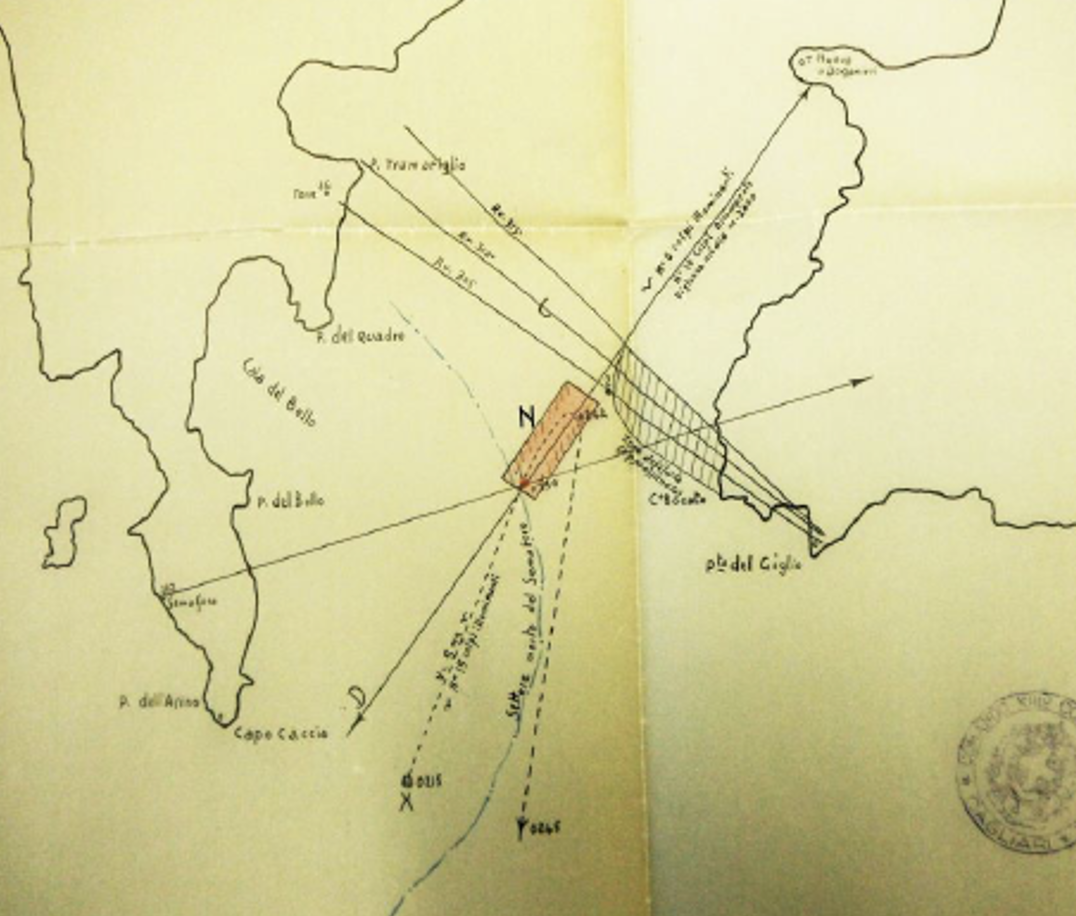
Reconstruction of the attack by the Maori (shown as N) at Porto Conte on August 1st, 1941 (by permission of AUSSME (5))
The 145th battery (positioned at Cantaro, south of Alghero) did not fire because two of the four guns were, since some time, out of order and they were the ones pointed towards Capo Caccia. The guns were afterwards replaced, in February 1942.
The commander was challenged for not having rotated one of the working guns to cover also that area.
About the 103rd battery (positioned on an esplanade between the mounts Murone, Vaccargiu and Doglia), where the commander arrived late in his command post, the justification for not firing was that the ship was out of range of the howitzers aimed at counteract a landing and not to shoot a ship. The distance was, nevertheless, assessed with binoculars and not with a range finder.
The 60 cm searchlight, of Torre Nuova at Porto Conte, was not turned on. Still, even if the switching on was not necessary since the Maori was easily spotted by the blazes of her guns and by her searchlight, the justification was that the orders were unclear.
However, just to dispel any doubts, on August 2nd 1941, general Mora issued a dispatch in which, among others, it was ordered «the immediate lighting of the searchlight by decision of the head of the station, in case of any type of alert».
In conclusion, an Italian-style mess where deficiencies in command lines, delays, lack of initiative and inaccuracy, led to the failure to react by our artilleries.
Who knows what the British seamen thought: probably they must have wondered why there was no reaction and, maybe, they had a few laughs about the inefficiency of the Italian Royal Army.
In any case it was not a great deed: about thirty shots fired with just the result of having forced the Finance Police to eat cold meal since the only damage was to the kitchen of their barracks in Porto Conte.
The Cossack hit twice the headlines. The first was in February 1940, when a few of her seamen boarded the German oil tanker Altmark, at anchor inside a Norwegian fjord, to free about 300 British prisoners detained in the tanker. Hitler took advantage of the episode to invade the Norway that was, then, neutral.
The second was in May 1941 when she took part, together with the Maori and other British warships, to the hunt and the following sinking of the German battleship Bismark.
The two British destroyers were, later, sank: the Cossack hit by a torpedo in October 1941 and the Maori hit by a bomb in Malta harbour in February 1942: tragic war Nemesis.
In book references
(1) Weekly Resumé n101 of 1941
(2) http://www.hmscossack.org/download/SOME%20SURVIVORS’%20NARRATIVES.doc
Notes not in the book but added for comprehension
(3) Carabinieri are an Italian Police Forces
(4) Guardia Alla Frontiera are Border Guard Corps
(5) It is the acronym for the Archives of the Historical Office of the High Command of the Italian Army
The SR 413 battery at Punta del Giglio was armed with 102/35 guns
The 145th battery was armed with 152/45 guns
The 103rd battery was armed with 149/12 howitzers
Reconstruction with today’s aerial and satellite photographs.
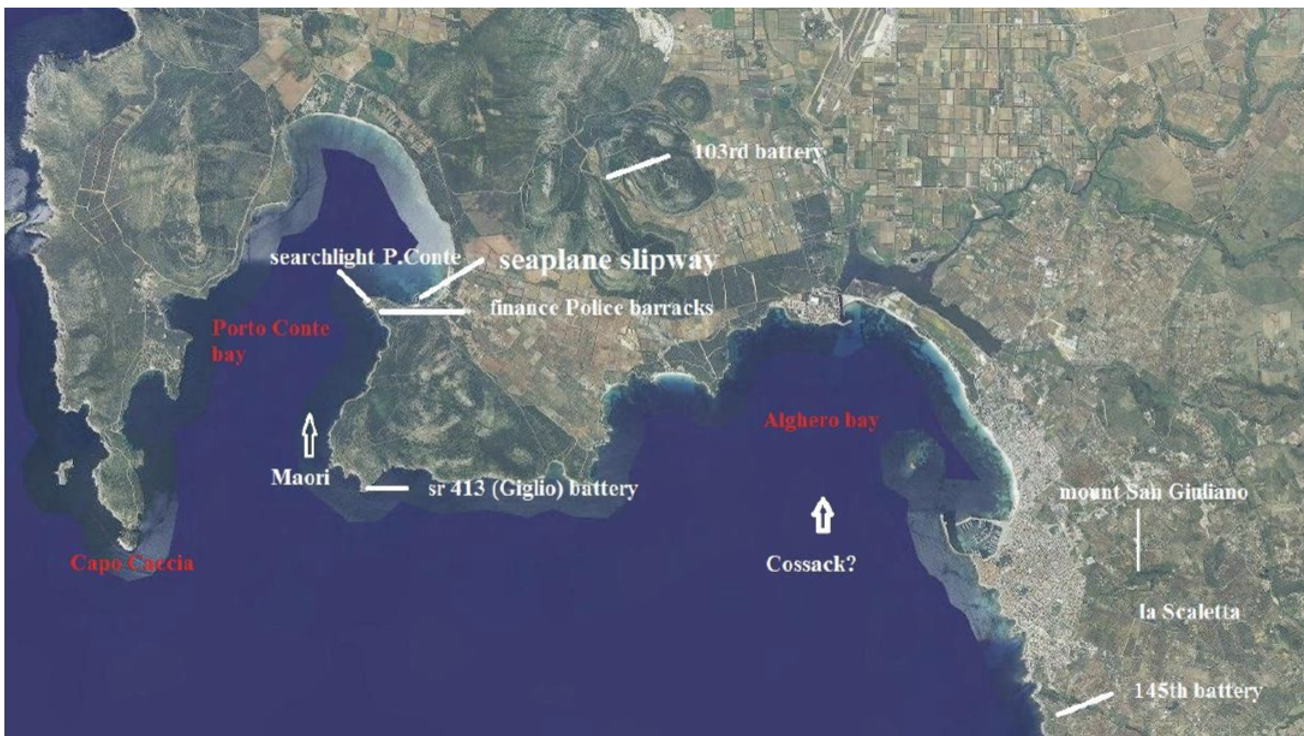
Reconstruction of the Cossack and Maori raid. Most likely it was the Cossack that hit mount San Giuliano and La Scaletta. (Sardinia Region, aerial and satellite photographs)
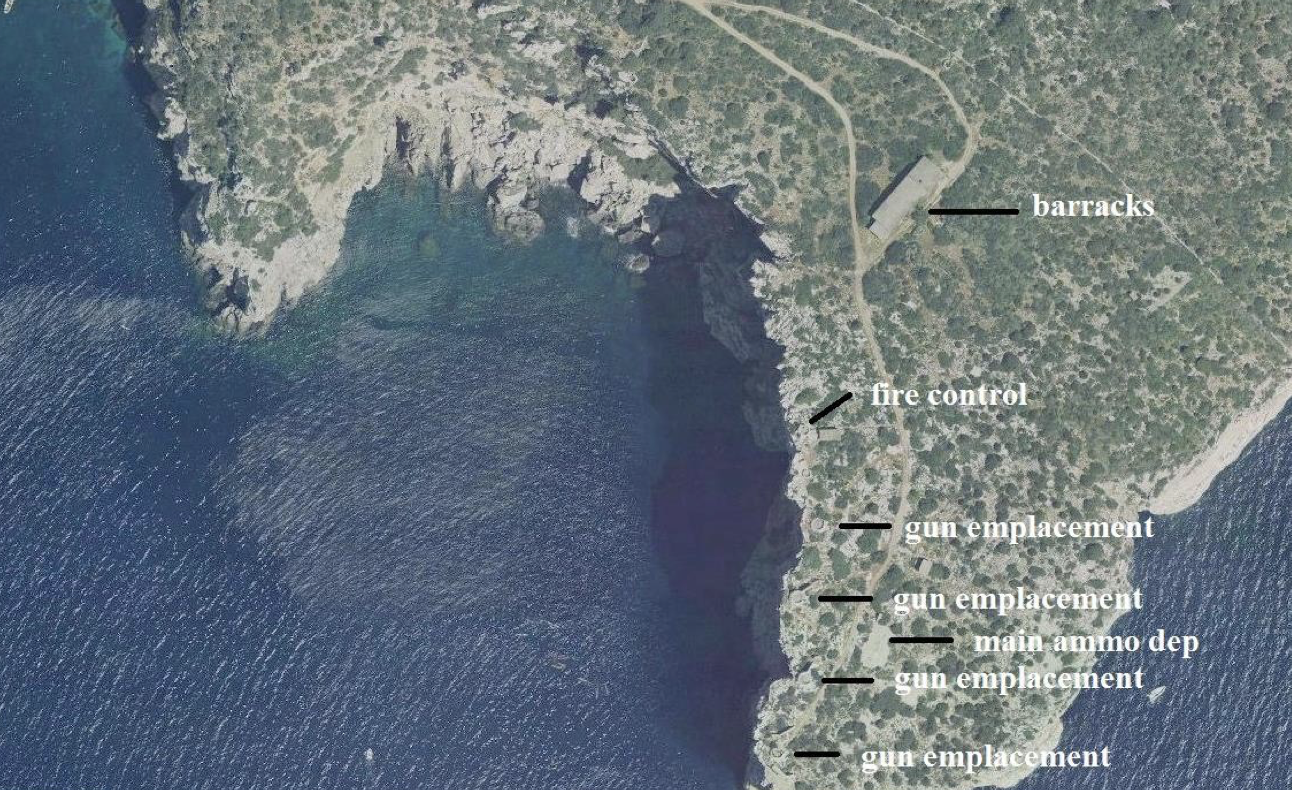
Sr 413 battery (Google Earth photograph)
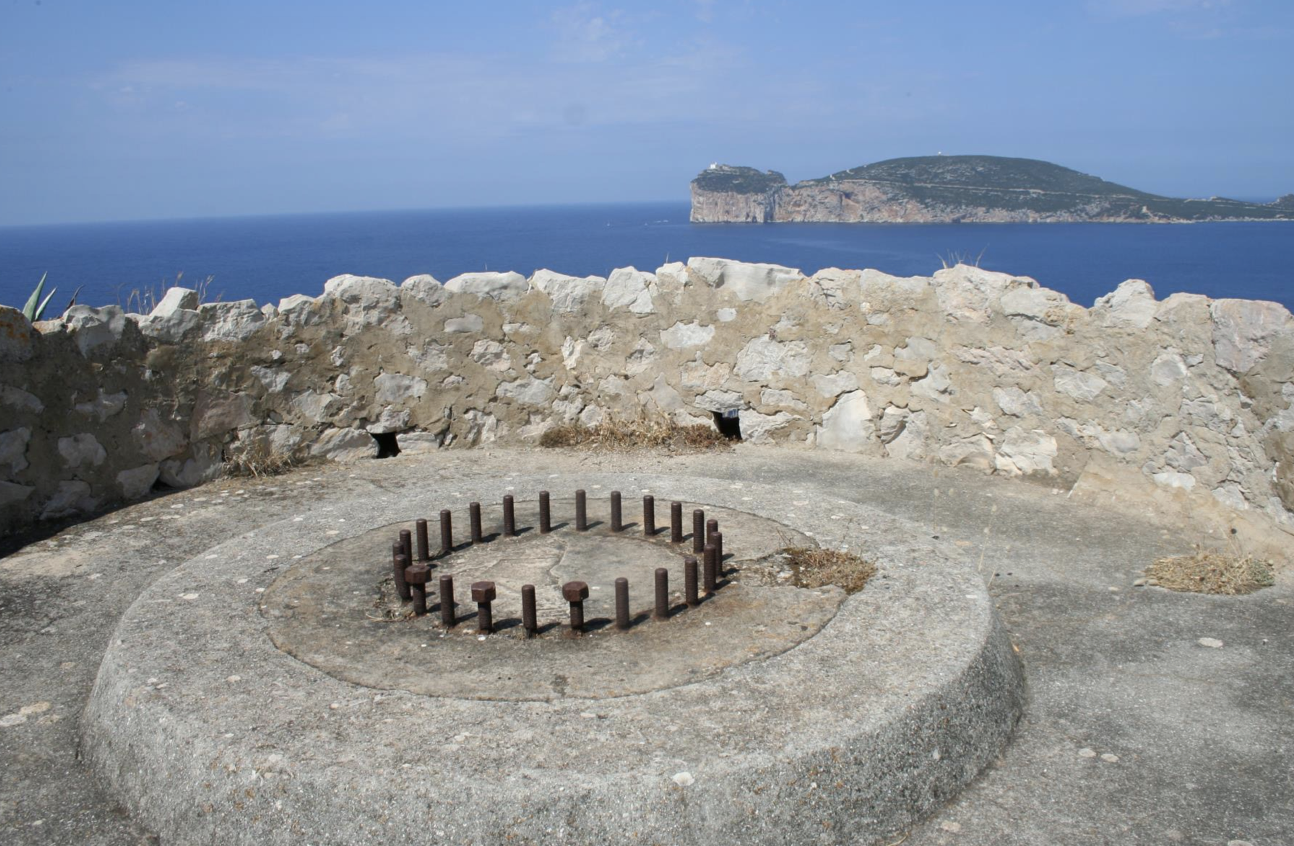
Sr 413 battery gun emplacement. On the background Capo Caccia, with the lighthouse. With the maximum range of 12km the 102/35 guns could have hit the Maori on her way back to the convoy, the battery had also its own searchlight.
18 August 1941
The Clyde for Operation Halberd convoy WS11X (GM2) to Malta
Escorted empty convoy from Malta to Gibraltar.
Merchantmen: BRECONSHIRE, IMPERIAL STAR, CITY OF CALCUTTA, AJAX, DUNEDIN STAR, CLAN FERGUSON, ROWALLAN CASTLE, CLAN MACDONALD, CITY OF LINCOLN.
Close Escort Group 11
PRINCE OF WALES, RODNEY, KENYA, EDINBURGH, SHEFFIELD. EURYALLUS. Destroyers DUNCAN, LEGION, LANCE, LIVELY, GURKHA,. ORIBI, FURY, FARNDALE, HEYTHROP, PIORUN (Polish), GARLAND (Polish), ISAAC SWEERS (Netherlands)
Convoy Group 1
NELSON
Force H
ARK ROYAL, HERMIONE, Destroyers: COSSACK, ZULU, FORESIGHT, FORESTER, LOFOREY, LIGHTNING. Tanker: BROWN RANGER. Corvettte FLEUR de LYS. Submarines: UTMOST, TRUSTY, SOKOL (Polish)