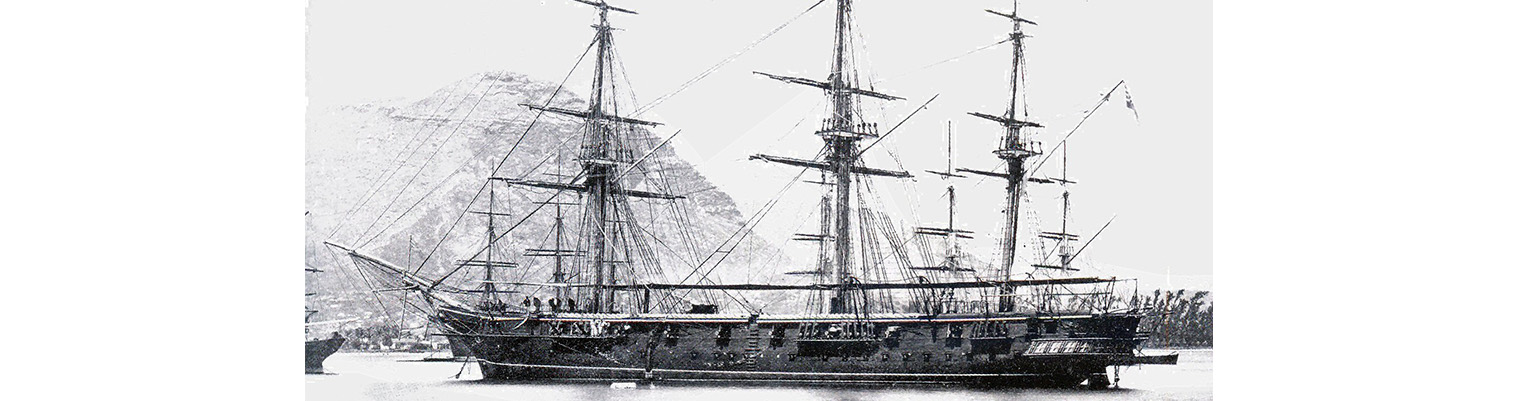
This is the story of the second ship to bear the name HMS Cossack.

Originally ordered by Russia for the Black Sea Fleet in December 1852 at a cost of 290,000 silver roubles, the ship was sold to the Hamburg trading house of Henry Mersk & Co. when relations between Britain and Russia deteriorated, as Russia feared possible confiscation.

The original contract price for the vessel, then named Witjas (Cossack), was £46,198, including £16,750 for machinery. The Admiralty subsequently paid the contractors £9,591 to complete the contract (of which £4,187 was for machinery), plus £751 for tonnage exceeding the specification and £2,206 for modifications for His Majesty’s service. The ship remained in service until 1875.

Year by Year

Discover the history of the HMS Cossack from 1854 to 1875.

You can search the ‘year’ and ‘month’ to find a specific date and also ‘click’ on the date itself to reveal any images and moments from that date.

27 May 1872

Wind south easterly force 3 to 4 becoming ESE force 2.

Repairing, bending sails and rattling down rigging.

28 May 1872

Wind ESE force 2  becoming light and variable. Barometer 30.08 inches. Maximum temperature 85F.

Repairing, bending sails and rattling down rigging.

29 May 1872

Wind light and variable becoming NNW force 1. Barometer 30.06 inches.

Repairing, bending sails and rattling down rigging.

30 May 1872

Wind NW force 1 becoming NNW force 2.

Repairing, bending sails and rattling down rigging.

31 May 1872

Wind NW force 2 becoming south westerly force 2. Barometer 30.02 inches. Maximum temperature 85F.

Repairing, bending sails and rattling down rigging.

01 June 1872

Wind SW force 2 becoming SSW.

Received water and cleaned ship

02 June 1872

Wind variable becoming southerly force 2.

Performed Divine Service.

03 June 1872

Wind southerly force 3 becoming SSE force 4.

Laid an embargo on Barque METEOR and schooners MARIA DOUGLAS and MARION RENNIE; the former sailing under two owners one of them being a foreigner and therefore illegal, the latter having no papers Vid. The Shipping Act.

04 June 1872

Wind SSE force 4 becoming south easterly force 5.

Employed as requisite.

05 June 1872

Wind south easterly force 3 increasing to 4. Barometer 30.17 inches.

As requisite

06 June 1872

Wind SSE force 2 becoming ESE force 3.

As requisite

07 June 1872

Calm and light airs becoming easterly force 1.

Exercised at General Quarters.

08 June 1872

Wind west to south  becoming ENE  force 1. Barometer 30.06 inches. Maximum temperature 82F.

Sent prisoners from Barque CARL to British Barque DUKE OF EDINBURGH for passage to Sydney.

09 June 1872

Wind northerly force 2 becoming north westerly force 2.

Watering ship per launch ( in bulk). Cleaning ship. Performed Divine Service.

10 June 1872

Calm then southerly force 1 becoming south force 1 to 2.

Employed as requisite.


Remarks

During our stay which was close on a month we had the SE trade wind nearly the whole time. Generally from SSE hauling to the eastward as the day advanced with the barometer steady at a mean 30.06 inches. Temperatures – before our arrival here they had the same weather as we had a at Matuku which is considered rather unusual at this time. Occasionally the wind was from the westward and NW with rain and in…

Calm then southerly force 1 becoming south force 1 to 2.

Employed as requisite.


Remarks

During our stay which was close on a month we had the SE trade wind nearly the whole time. Generally from SSE hauling to the eastward as the day advanced with the barometer steady at a mean 30.06 inches. Temperatures – before our arrival here they had the same weather as we had a at Matuku which is considered rather unusual at this time. Occasionally the wind was from the westward and NW with rain and increasing the rain very much.

The beacons are not so conspicuous  as you might wish for; they being small; about the size of a sentry box; and of slate colour with a red diamond painted on the front face. We were puzzled in trying to make them out on the Harbour Master (Whom we had taken onboard but did not avail ourselves of his aid) alluding to them.

A pilot came off in a whaler boat but we did not require him and then we gave him a tow in.  Shortly afterwards the Government pilot and harbour master came off and who was allowed on board on our seeing he carried the Fijian Flag. (Blue and white perpendicular with a red crescent and a white dove with a sprig in its mouth in the centre)

[Current flag

The Union Jack (upper left), is representative of the country’s long association with Great Britain. The flag’s blue field is symbolic of the surrounding Pacific Ocean. The coat of arms display a golden British lion holding a cocoa pod, as well as panels displaying a palm tree, sugar cane, bananas and dove of peace.]

He gave us to understand we could not take a position abreast of the Kings Pier on account of our being in the way of the traders of the place which was ridiculous 

The reef is well defined at the entrance and dry in several places at low water. Also the bank in  the centre of the harbour dries at low waters and a rock to the northward of the town about a cables length off shore is awash at low water.

11 June 1872

Wind SSE force 2 becoming SE by E force 1 to 2. Barometer 30.02 inches. Preparing for sea.

1200. Weighed under sail  with light SSE wind and beat out in 2 ½ hours.

1330 Shaped course to north to pass through Wakaia (Wakaya) Island.

1600. Pottage Island NW. Mokongai NE.

1800. Point Makindrage E by S and Pottage Island west.

2200. Passed through channel which people said was impossible for large vessels to go through owing to a strong current but we did find such to be the case.

Midnight. Wind f…

Wind SSE force 2 becoming SE by E force 1 to 2. Barometer 30.02 inches. Preparing for sea.

1200. Weighed under sail  with light SSE wind and beat out in 2 ½ hours.

1330 Shaped course to north to pass through Wakaia (Wakaya) Island.

1600. Pottage Island NW. Mokongai NE.

1800. Point Makindrage E by S and Pottage Island west.

2200. Passed through channel which people said was impossible for large vessels to go through owing to a strong current but we did find such to be the case.

Midnight. Wind fell calm.

12 June 1872

Wind ENE force 2 decreasing to 1.0. commenced steaming.

0840 Sighted Vanua-Leva 9 Great Land) and had wind spring up from ENE.

1340. Anchored in 15 fathoms with broken bottom on east side of Savu Savu Bay.

The shores here is lined with coral patches and vessels should not anchor in less than 20 fathoms for we found the next day we were uncomfortably close to a patch.

13 June 1872

1400. Anchored in Sarn-Sarre (?) Bay. Wind calm becoming NW and SSW force 2. Barometer 30.06 inches. Maximum temperature 85F.

1040. Shortened in to 2 shackles. Cutter sounding.

1330. Weighed under steam and proceeded out through reef which was well defined.

1355.  Sounded in36 Fathoms ( Coral)

1400. Sounded in 45 fathoms 9 Mud). 1430. Stopped and banked fires.

1500. Shaped course ESE.

2000. Lightning to the eastward.

14 June 1872

1330.Weighed under steam for Vuna Point. Wind southerly force 1. Barometer 30.12 inches. Light southerly wind.

0350. Observed land on port bow. Wind fell, furled sails and commenced steaming on E by N.

1315. Stopped and sent cutter sounding.

1330. Came to off Tarruna (?) Island with broken  bottom in 32 fathoms and veered to 4 ¾ shackles. Anchorage bearings Coralib Island  N22E.  Vuna Point south.


Remarks

At Savu Savu there was a large store and ginning establishment and boat building…

1330.Weighed under steam for Vuna Point. Wind southerly force 1. Barometer 30.12 inches. Light southerly wind.

0350. Observed land on port bow. Wind fell, furled sails and commenced steaming on E by N.

1315. Stopped and sent cutter sounding.

1330. Came to off Tarruna (?) Island with broken  bottom in 32 fathoms and veered to 4 ¾ shackles. Anchorage bearings Coralib Island  N22E.  Vuna Point south.


Remarks

At Savu Savu there was a large store and ginning establishment and boat building shed which is considered the dockyard of Fiji. There are also a great many plantations more inland. The whites numbering about 200. Taveuni Island is considered the finest islands in the group and in consequence has a great many plantations. It is certainly the best in appearance.  The weather during our stay was generally cloudy with occasional heavy showers. The wind veering from North, NNW to SSE and always light. The reef off Vuna Point showed out very plainly. At our anchorage we swung in 55 fathoms ( Coral) and inshore appeared to be foul ground. Better off we should not anchor in less than 30 fathoms.


15 June 1872

13.30 anchored north of Vuna Point. (Now called Taveuni Island Latitude 16.59S. Longitude 179.54W). Wind northerly force 2 becoming NW force 2.

Employed as requisite.

Hidden Gems

The Island of Kotka was attacked in 1855, but the garrison had already departed: barracks, stores and magazines etc were destroyed and the squadron left, leaving COSSACK in charge of the Island.

Anchor crest

Receive our newsletters?