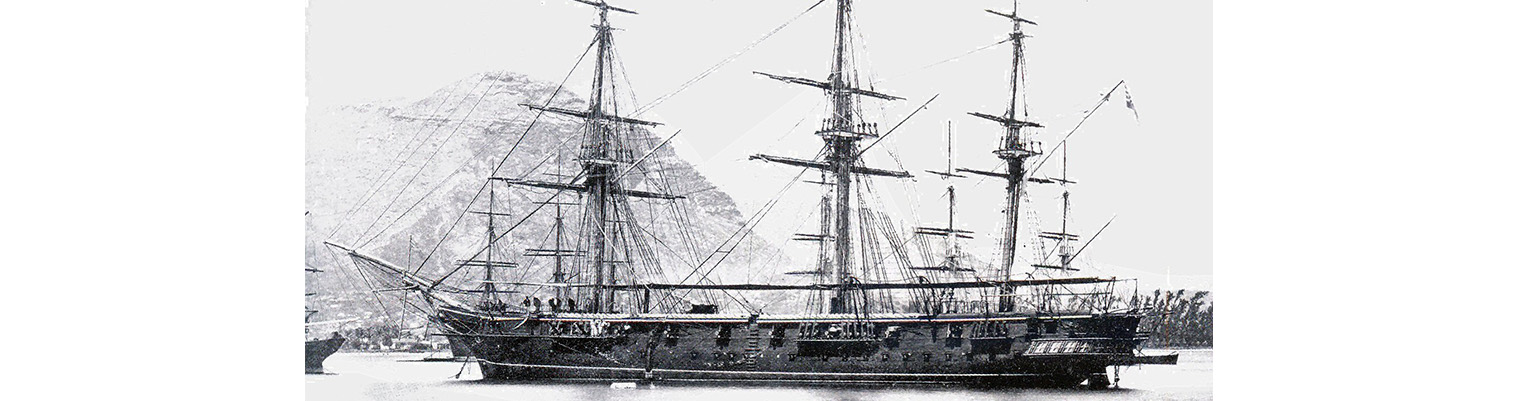
This is the story of the second ship to bear the name HMS Cossack.

Originally ordered by Russia for the Black Sea Fleet in December 1852 at a cost of 290,000 silver roubles, the ship was sold to the Hamburg trading house of Henry Mersk & Co. when relations between Britain and Russia deteriorated, as Russia feared possible confiscation.

The original contract price for the vessel, then named Witjas (Cossack), was £46,198, including £16,750 for machinery. The Admiralty subsequently paid the contractors £9,591 to complete the contract (of which £4,187 was for machinery), plus £751 for tonnage exceeding the specification and £2,206 for modifications for His Majesty’s service. The ship remained in service until 1875.

Year by Year

Discover the history of the HMS Cossack from 1854 to 1875.

You can search the ‘year’ and ‘month’ to find a specific date and also ‘click’ on the date itself to reveal any images and moments from that date.
08 March 1872

Wind SSE force 2 becoming southerly force 1. Maximum temperature 64F as requisite.

09 March 1872

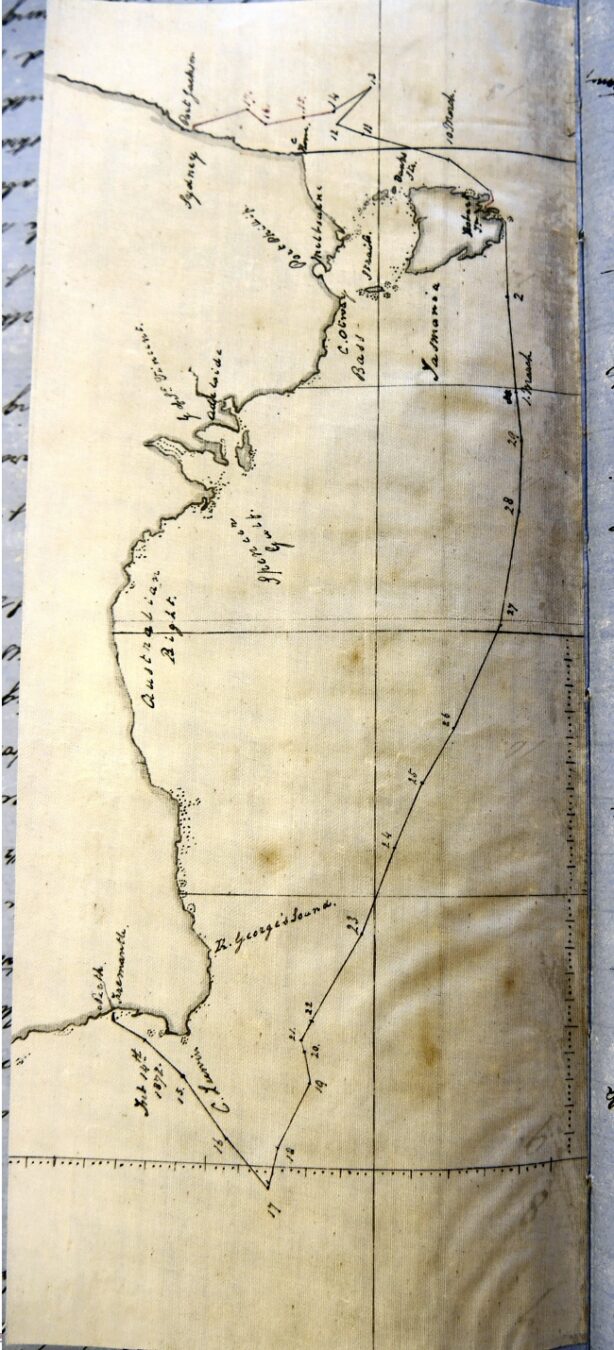
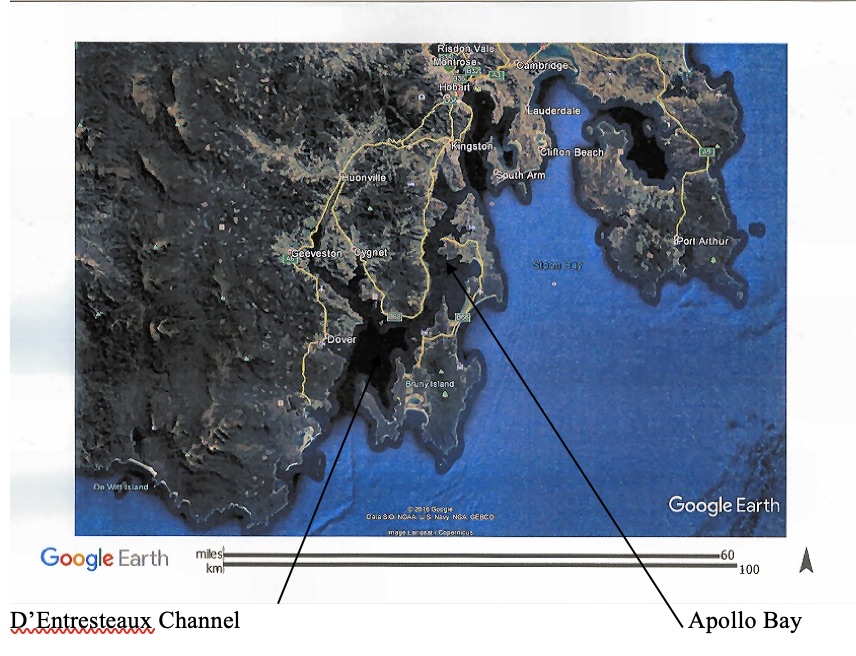
1030. Left Hobart under steam and proceed out via Storm Bay.  Wind calm northerly light airs becoming south easterly force 1 to 2 and later southerly force 2. Under sail.

Noon. Trymark Point ENE 1/ ½ miles.

1300 Shaped course SE. Iron Point Lighthouse N78E, Yellow bluff S13E.

1715. Stopped made plain sail on starboard tack. Up screw. Altered course E by S with wind south.

1800 Cape Haone N10W. In first and second reefs Topsails.

2100 Cape Pillar N ½ E 10 miles.

2000. Course NNE. Midnight Wind…

1030. Left Hobart under steam and proceed out via Storm Bay.  Wind calm northerly light airs becoming south easterly force 1 to 2 and later southerly force 2. Under sail.

Noon. Trymark Point ENE 1/ ½ miles.

1300 Shaped course SE. Iron Point Lighthouse N78E, Yellow bluff S13E.

1715. Stopped made plain sail on starboard tack. Up screw. Altered course E by S with wind south.

1800 Cape Haone N10W. In first and second reefs Topsails.

2100 Cape Pillar N ½ E 10 miles.

2000. Course NNE. Midnight Wind WNW force 3 to 4.

10 March 1872

Latitude  42.2S. Longitude 149.32E. Course N39E from 2000 hours. Wind  south westerly force 4 becoming SW force 4 followed  by SW force 4. Under sail. Maximum temperature 60F.

Daybreak. Land on port bow.

1000. Lost sight of land. The wind during the forenoon veered to the SW and southward with slight squalls of rain and wind. After a few minutes worked round to SE and at midnight was ESE with weather. Barometer rising.

11 March 1872

titude 39.25S. Longitude 149.32E. Course N10E. Wind ESE force 3 becoming ENE force 3.

Under sail. Barometer 10.37 inches. Moderate breeze from eastward and ENE. Under all plain sail until sunset. Braced forward, reefed Topsails, in Royals.

Noon. Course  North. Expecting to have a south easterly set from land.

12 March 1872

Latitude 38.33S. Longitude 151.8E. Course N24E. Wind NE force 4 becoming NE by N.

Under sail. Wind veered still to the northward of which it showed signs of doing yesterday evening.

0300. Wind was at NNE and consequently we were obliged to tack. The wind during the day between NNE and NE. Ship making about E by S. weather cloudy and squally.

13 March 1872

Latitude 39.36E. Longitude 152.44E. Course S50E. Wind NE by N  force 5 to 6 becoming north easterly force 6.

Under sail. Wind and weather same as yesterday. Barometer steady at 30.20 inches.

1300. Wore having bought south Head Light to bear N12W

14 March 1872

Latitude 38.32E. longitude 151.45E. Course N36W. Wind north easterly  force 5 decreasing to 4. Under sail. Weather cloudy and squally. Wind from NE by N to NE by E.

2300 Wore ship. Wind veering to NE. Barometer slowly falling 29.98 inches.

15 March 1872

Latitude 37.28. Longitude 151.40E. Course N4W. Wind NE  force 3 to 4  becoming NE by N force 3. Under sail.

0345. Wore Ship. Light breeze form NE. Under all plain sail.

2000.Wind falling light from NNE. Commenced steaming. Shaped course north.

16 March 1872

Latitude 36.16S. Longitude 151.7E. Course N20W. Wind  N by E force 2 becoming force 3.

Under sail. Maximum temperature 76F. Steaming with fore and aft when they would draw.

Noon. Altered course to  N by E ½ E. 1700.made sail on port tack, wind NNE. Barometer falling 29.83 inches.

17 March 1872

Latitude 35.39S. Longitude 152.1E. Course N50E.  Wind north force 3 becoming westerly  force 2 and later southerly 3 to 4.Under sail.

0400. Wind north; tacked. Barometer 29.78 inches. During the night vivid lightning to northward.

0900 Wind fell light and variable almost suddenly and then freshened up from westward. Tacked with wind gradually hauling aft. During the rest of the  day was from south and SSE blowing fresh. Barometer rising since 0800. Gradually rising from 2980 inches at midnigh…

Latitude 35.39S. Longitude 152.1E. Course N50E.  Wind north force 3 becoming westerly  force 2 and later southerly 3 to 4.Under sail.

0400. Wind north; tacked. Barometer 29.78 inches. During the night vivid lightning to northward.

0900 Wind fell light and variable almost suddenly and then freshened up from westward. Tacked with wind gradually hauling aft. During the rest of the  day was from south and SSE blowing fresh. Barometer rising since 0800. Gradually rising from 2980 inches at midnight to 30.01 inches.. altered course to N by W ½ W and NW by N having a strong south easterly current against us.

18 March 1872

1300. Arrived and moored to buoy in Farm Cove, Port Jackson. Sydney. Wind south force 3 to 4 decreasing to 3.

Daylight.  Land on port bow but could not tell what part. Stood west to close land for we had expected to sight the lights on Outer South Head early and the latter we did not sight until about 0800 which gave us a current setting to the  south eastward nearly 2 knots per hour. The lighthouse bore on sighting NW by N.

0930. Shortened and furled sails. Proceeded under steam still feeling…

1300. Arrived and moored to buoy in Farm Cove, Port Jackson. Sydney. Wind south force 3 to 4 decreasing to 3.

Daylight.  Land on port bow but could not tell what part. Stood west to close land for we had expected to sight the lights on Outer South Head early and the latter we did not sight until about 0800 which gave us a current setting to the  south eastward nearly 2 knots per hour. The lighthouse bore on sighting NW by N.

0930. Shortened and furled sails. Proceeded under steam still feeling the current.

1145. Stopped and took on pilot. Proceeded.

1245. Arrived in Farm cove and took in moorings. Down upper yards and masts. Out boom boats. Unbent sails. Wind fell light with heavy rain.


Remarks

During our passage it will be seen from the above that we had constant northerly, north westerly winds until within a day of Port Jackson when it shifted to southward with a rising barometer. Current generally setting to the south viz two day setting  to SW by W 30 miles per day and 4 days setting to the SSE from 15 to 20 miles per day but these were not at all regular for sometimes there would not be any current the next day. We has a strong easterly current for one day abreast of Bass’s Straights. A government pilot boarded vessels of war and consequently we were taken in by one who said that the Western Channel was always used but would give no particular reason  for not using the Eastern Channel although we heard from the harbour master that it was a good channel but  that they the pilots had an obligation to use it.

The harbour is the finest in Australia and perhaps of the best in the world; bieing5 ½ miles from the entrance to Sydney Cove with wharves in Woolloomlloo Bay, Sydney Cove and Darling Harbour with several slips.  It is very easy to come up the harbour by following the Sailing Directions which are given very clearly and fully. The marks are easily made out. Several forts are in the course of construction on either side of the entrance. On arriving here we shackled our cable to the buoy in Farm Cove, which is used for the Flagship when they are here. Our launch and paddle boat were used in bringing water off from the jetty Our chronometer Webb was rated by Time ball at 1300 mean time Sydney. The other two Frodsham and Arnold were sent ashore to J Allerding – Chronometer and Watch Maker. The former having stopped at Freemantle and the other no rate at all. They were placed in his hands shortly after our arrival and were received on board about the 16 April having been rated and keeping very good time

19 March 1872

At moorings. South force 3. Barometer 30.16 inches. Maximum temperature 62F.

Employed unreeving running gear, hoisting out and landing MEGAIRA’s stores at Commonwealth Stores, Sydney Cove using our boom boats. Fresh southerly wind with squally, cloudy and rainy weather.

20 March 1872

Wind south force 3. Maximum temperature 72F.

Landing MEGAIA’s stores. Employed watering ship

21 March 1872

Wind south westerly  force 1 to 2 becoming south force 1 to 2.

Employed hoisting out, landing and storing MEGAIRA’s stores in Commonwealth Store. Refitting fore yard gear

22 March 1872

Wind south westerly force 1 becoming NW force 1 and light airs later. Maximum temperature 82F.

1600. Employed hoisting out, landing and storing MEGAIRA’s stores. Rigged shears for unshipping rudder.

1600.Unshipped rudder and landed it at Garden island

23 March 1872

Wind north westerly  force 1 to 2. Becoming calm with light airs.

Surveying officers surveying rudder at Garden Island and in their report recommended that as the rudder head was not completely decayed  a new main piece was adequate and therefore  a spar being chosen by the Carpenter was bought by the Commissariat and handed over to us. Setting up Topmast rigging and refitting ship.

24 March 1872

Wind westerly force 1 to 2 becoming south easterly force 1.

Sunday. Sent Roman Catholics to chapel.

25 March 1872

Calm becoming easterly force 2.

Rattling down rigging and refitting Ship.

26 March 1872

Winds light and variable becoming south westerly force 2. Maximum temperature 79F.

Employed  as yesterday and surveying officers surveying MEGAIRA’s stores on shore. Carpenters repairing rudder.

27 March 1872

Wind W by N force 5 becoming west force 4.

Employed refitting ship and hoisting screw on deck.

Hidden Gems

The Island of Kotka was attacked in 1855, but the garrison had already departed: barracks, stores and magazines etc were destroyed and the squadron left, leaving COSSACK in charge of the Island.

Anchor crest

Receive our newsletters?