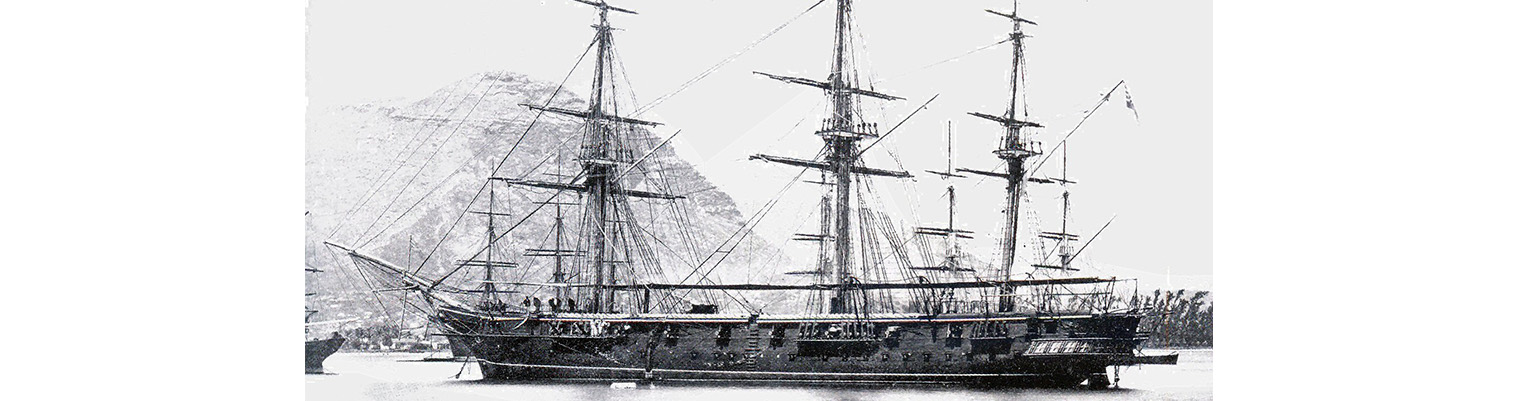
This is the story of the second ship to bear the name HMS Cossack.

Originally ordered by Russia for the Black Sea Fleet in December 1852 at a cost of 290,000 silver roubles, the ship was sold to the Hamburg trading house of Henry Mersk & Co. when relations between Britain and Russia deteriorated, as Russia feared possible confiscation.

The original contract price for the vessel, then named Witjas (Cossack), was £46,198, including £16,750 for machinery. The Admiralty subsequently paid the contractors £9,591 to complete the contract (of which £4,187 was for machinery), plus £751 for tonnage exceeding the specification and £2,206 for modifications for His Majesty’s service. The ship remained in service until 1875.

Year by Year

Discover the history of the HMS Cossack from 1854 to 1875.

You can search the ‘year’ and ‘month’ to find a specific date and also ‘click’ on the date itself to reveal any images and moments from that date.

26 January 1872

Latitude 32.32S. Longitude 108.6E. Course N72E. Wind SE by S force 3 to 4 becoming SSE force 4. Under steam and sail.

Daybreak. Wind fresh and inclined to draw to the eastward.

0900. Commenced steaming as breeze fell light from SE. Wishing to keep to the southward of Fremantle and Beaver Reef. Heavy swell from SW and a strong westerly current which I dare say was caused by its setting round the Cape Leeuwin to the westward.

27 January 1872

Latitude 32.7S. Longitude 110.29E. Course N78E. Wind SSE force 3 to 4 becoming south force 4. Under steam.

0600. Passed English brig ELIZA BLANCHE standing SW. She was the only vessel we saw on this trip and she arrived at Fremantle  3 or 4 days after us.

Steaming all day. Steering ESE with all plain sail.

28 January 1872

Latitude 32.26S. Longitude 113.18E. Course S82E. Wind south  force 4 increasing to 5. Under steam and sail. Barometer 29.95 inches. Steady southerly wind.

1600. Wind freshened so much that we stopped steaming and proceeded under plain sail save Royals and going 10 knots. Kept a sharp lookout for Rattnest Light during the first watch but it was not sighted. Course since 200 E by N

29 January 1872

At single anchor. Gage Roads. Western Australia. Wind south force 1 to 2 becoming SSW 3 to 4.  Maximum temperature 77F.

0230. Sighted Rattnest Light NE about 3 miles. Immediately altered course to NW as we were ought to have seen it at the distance of 15 to 20 miles being a fine and clear  night. Shortly afterwards it was observed that the light was totally eclipsed for about 4 or 5 minutes which showed the machinery was rather out of order. (From enquiries made later it was proved to be the c…

At single anchor. Gage Roads. Western Australia. Wind south force 1 to 2 becoming SSW 3 to 4.  Maximum temperature 77F.

0230. Sighted Rattnest Light NE about 3 miles. Immediately altered course to NW as we were ought to have seen it at the distance of 15 to 20 miles being a fine and clear  night. Shortly afterwards it was observed that the light was totally eclipsed for about 4 or 5 minutes which showed the machinery was rather out of order. (From enquiries made later it was proved to be the case and steps taken to repair it.)

0300.  Down screw and commenced steaming..

0600. Rattnest Light W ½ N Stragglers S ½ W. Stopped and came to with sandy bottom in 5 fathoms and veered to 42 fathoms. Anchorage bearings. Light House S88E Menstone S70W.

100. His Excellency Governor Wild landed. Unfurled mainsail, out boats. Down main yard for survey which was found rotten in starboard quarter which appeared to have been occasioned  from old sore having been putted up and the water having found its way in had rotted the inside for about 15 feet. It was also sprung just outside the boxing on the starboard quarter and therefore the starboard yardarm was cut off.  The schooner WATER LILY arrived 3 or four days before us having left the day after from Tien Tsin ( Cossack). She appears to kept in the shore taking advantage of the land breezes which are during this month well from the eastward. She reported that there had been a heavy easterly gale almost appearing as a hurricane the day after we left harbour.


31 January 1872

Wind ESE force 2 becoming SW force 3. Barometer 30.07. maximum temperature 74F.

Repairing main yards, refitting Top gallant and Royal rigging and as requisite

01 February 1872

At single anchor in Gage Roads. Wind easterly force 2 becoming SW force 2. Barometer 30.02 inches.

Up to the 5 February employed about Main yards, repairing Topsails and Courses.

02 February 1872

Wind east force 3 to 4 becoming SSW force 3 to 4 with broken cloud.

03 February 1872

Wind east force 1 to 2 becoming SSW force 2 to 3. Maximum temperature 76F.

04 February 1872

Wind easterly force 2 to 3 becoming S by W force 3.  Maximum temperature 80F

05 February 1872

Wind easterly force 2 becoming SSW force 2. Barometer 30.08 inches.

Coaled ship from coal lighter – 75 tons.

06 February 1872

Wind easterly force 2 to 3. Becoming S by W force 2. 6th to 11.

About main yard, gave General Leave and received MERAIR’s stores from the Control Stores, Fremantle. Main yard was repaired with a spar ( Yellow pine from shore) scarped to the other part of the yard.  Half dozen bolts driven through, our own four iron fishes ( Long metal pieces convex on one side and concave on the other which are bound round the yard to strengthen it) were used. The yards were ready on the 11th for service.

07 February 1872

Wind easterly force 4 becoming light and variable later. Maximum temperature 82F.

08 February 1872

Wind easterly force 3 to 4. Becoming south westerly force 2.

09 February 1872

Wind ENE force 3 to 4 decreasing to force 1 to 2. Maximum temperature 90F

10 February 1872

Wind easterly  force 1 becoming light and variable from the SE and ESE. Barometer 29.93 inches. Maximum temperature 75F.


Remarks

During our stay this time we had fine weather with strong land and sea breezes with the exception of the last two or three days when we had a shift of wind from the NW bringing rain and the barometer falling slightly until the wind set in from SW again with the usual fine weather. Salt meat etc were purchased here for the Ship’s company.

11 February 1872

Wind variable force 2 becoming NW by N force 3.

Employed preparing and securing cargo for sea.

12 February 1872

Wind north easterly force 2 becoming south westerly force 2. Barometer 30.06 inches.

13 February 1872

1900 weighed and proceeded out of Gage Roads. Wind south easterly force 1 becoming south force 3.

1800. Weighed under sail and proceeded out of Gage Road to north of Rottnest Island.

2200. Rottnest Light SW ½ W. Arthur Head Light SE. altered course west. Wind SE by S force 2 or 3.

Midnight. R0ttnest  Light SE ½ E. altered course to SW by S.

14 February 1872

. Latitude 33.00S. Longitude 114.29E. Course S30W.  Wind SE by E force 3 becoming SSE force 4.

Under sail. Course SSW. Strong current setting westward.

15 February 1872

Latitude 34.7S. Longitude 113.11E. Course S47W. Under sail. Wind sifted to S by E.

Exchanged Colours with an English ship standing NW. Cape Leeuwin bore east 100 nautical miles

Hidden Gems

The Island of Kotka was attacked in 1855, but the garrison had already departed: barracks, stores and magazines etc were destroyed and the squadron left, leaving COSSACK in charge of the Island.

Anchor crest

Receive our newsletters?