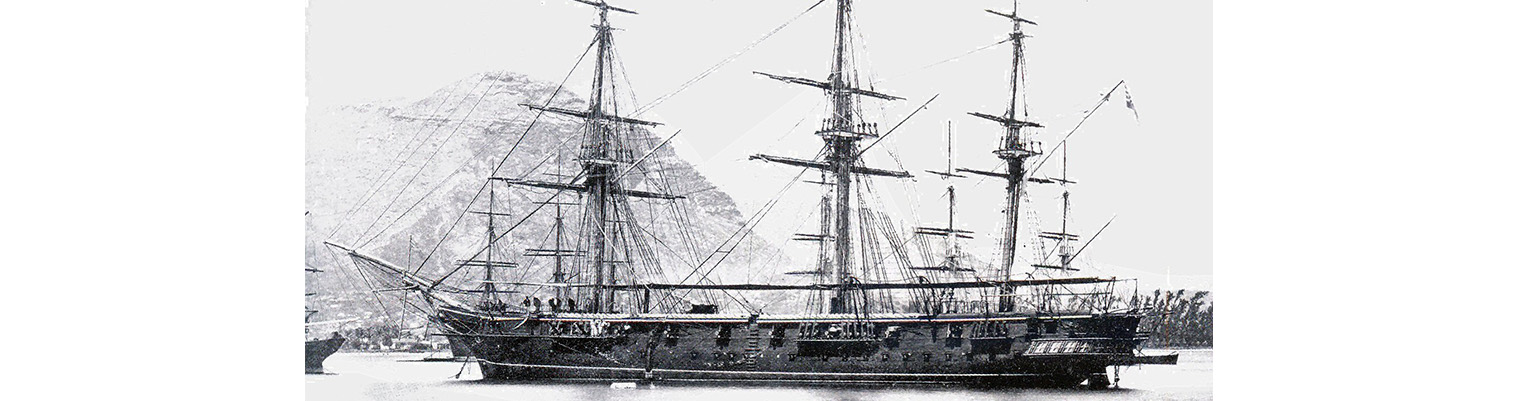
This is the story of the second ship to bear the name HMS Cossack.

Originally ordered by Russia for the Black Sea Fleet in December 1852 at a cost of 290,000 silver roubles, the ship was sold to the Hamburg trading house of Henry Mersk & Co. when relations between Britain and Russia deteriorated, as Russia feared possible confiscation.

The original contract price for the vessel, then named Witjas (Cossack), was £46,198, including £16,750 for machinery. The Admiralty subsequently paid the contractors £9,591 to complete the contract (of which £4,187 was for machinery), plus £751 for tonnage exceeding the specification and £2,206 for modifications for His Majesty’s service. The ship remained in service until 1875.

Year by Year

Discover the history of the HMS Cossack from 1854 to 1875.

You can search the ‘year’ and ‘month’ to find a specific date and also ‘click’ on the date itself to reveal any images and moments from that date.

13 February 1871

Wind ENE force 1 to 2 becoming NE force 1 to 2. Barometer 30.02 inches. Preparing to coal.

1000. French barque PERIE MAREI came alongside and secured.. Commenced coaling.

1800 Received 77 tons 12 cwt.

14 February 1871


14 February 1871. Wind calm and variable becoming NE force 1. Barometer rising to 30.06. coaling ship.

1400 Finished coaling ship. Received 168 tons. Barque hauled off and anchored.

15 February 1871

Wind calm and variable becoming NE force 1.

Hauled up launch and first cutter at dockyard.. Receiving Warrant Officer stores. Out kedge and 7” hawser as spring.. exercised at General Quarters firing at target.

1800 In kedge and hawser.

16 February 1871

Wind calm and variable becoming NE force 1.

Party at dockyard repairing sails. Employed grafting and pointing gun gear.

17 February 1871

Light airs becoming variable force 1.

Employed clearing holds. A party ashore drawing provisions. Also a party at Gun Wharf drawing shell. Steamer QUITO arrived. Employed cleaning hold.

18 February 1871

Calm becoming north easterly force 1.

Party at dockyard. Employed cleaning ship throughout. Watered by tank. Steamer QUITO discharging stores for dockyard.

19 February 1871

Calm becoming NE force 1.

0615. Steamer QUITO sailed. Mustered by the Open List. Performed Divine Service.

20 February 1871

Easterly force 1. Barometer 30.04 inches.

Third and fifth guns crews at rifle drill. Employed pointing and grafting ropes.

1600. Exercised at General Quarters.

21 February 1871

Calm becoming NNE force 1. Barometer 30.09 inches.

Field piece party on shore firing at target. Read articles of War.

1800. Down Top gallant yards and bent on sails.

22 February 1871

Wind NE force 1 to 2. Barometer 30.11 inches.

Exercised at General and Fire Quarters. Employed pointing and grafting ropes. Party at Gun Wharf drawing powder.. both companies of small arms and Marines at drill on shore.

23 February 1871

Wind NNE force 1 becoming N by E force 1.

0620. HMS FORTE arrived.

0800. Saluted flag of Admiral  Cockburn with 13 guns.  Received soap and tobacco. Employed  pointing ropes.

24 February 1871

Calm becoming N by E force 1.

Employed pointing and grafting ropes.

25 February 1871

Calm with broken cloud becoming NNE force 1. Cleaning ship. Field piece crew at drill on shore. 1800. Up screw and then lowered screw.

27 February 1871

Variable force 1 becoming East force 3.

Rear Admiral George .H Cockburn came onboard and inspected ship. Mustered by Divisions and Open list. Exercised at General and Fire Quarters. Employed preparing for sea. Discharged “time expired” men to HMS FORTE.

28 February 1871

Wind variable becoming ENE force 3.

Preparing for sea. In boom boats.

1230. Up steam in one boiler. Draught of water – Aft 18 feet. Forward. 16 feet 9 inches.

1410 Weighed and proceeded out under steam. Anchor came up foul fluke first and long bight of chain hanging down. Steamed slowly to clear it.

1600 Lit fires.

1625.. Flag staff  Point NNW. Round Island SW by W. Shaped course NE by E. Wind ENE force 4.

1730. William Brooks fell overboard. Stopped and let go life buoy. Lowered the cutter a…

Wind variable becoming ENE force 3.

Preparing for sea. In boom boats.

1230. Up steam in one boiler. Draught of water – Aft 18 feet. Forward. 16 feet 9 inches.

1410 Weighed and proceeded out under steam. Anchor came up foul fluke first and long bight of chain hanging down. Steamed slowly to clear it.

1600 Lit fires.

1625.. Flag staff  Point NNW. Round Island SW by W. Shaped course NE by E. Wind ENE force 4.

1730. William Brooks fell overboard. Stopped and let go life buoy. Lowered the cutter and picked up the man.

2000. Foul Point Light SW ¼ W. Passed two vessels passing to the south west. Set Fore and aft sail.


Remarks.

“On our arrival here there was no coal in the store as the FORTE had taken the last on her way to Calcutta but before we left two vessels had arrived with coal. The last one an English one over 5 months from the Tyne. The weather had been very fine having had rain only on two or three occasions with northerly winds. Generally during the morning we had calms and a light variable  airs and then the breeze set in from the north and east force 3 about noon and falling light towards Sunset. A small steamer (Paddle) arrived on the evening of the 27, 45 days from Port De Galle (Shri Lanka) where they had started for Singapore but failing for want of coal. She reached the Nicobar islands (a group of 19 islands, 12 of which are inhabited, between the Bay of Bengal and the Andaman Sea in the Indian Ocean near the Indian mainland. They cover an area of 1,600 sq km.) where she took plenty of wood onboard and through some means or other was found off Foul Point. The communication between this an Port De Galle is likely to be  improved by the arrival of a steamer from England for which the Harbour Master – Captain Varian has been sent home for the purpose of bringing her out.”

01 March 1871

Latitude 9.30N. Longitude 82.35E.  Course N55E. Wind E by S force 3 becoming ESE force 2. Barometer 30.08 inches. Under steam.

0800. Altered course to NE.

1030. Stopped. Machinery working very irregular. Found on inspection the key  of the after slide rod of the foremost engine had worked out. Continued under fore and aft sail until 2015. When we proceeded as before; also made sail to Top gallant sails. Wind hauled to the southwards of east. Course ENE

02 March 1871

Latitude 10.23N. Longitude 84.12E. Course N61E. Wind SE force 2 to 3 becoming E by S force 2.

Under steam and sail. Wind steady from SE force 3 but the weather very close. Administered corporal punishment to two marines and  one sailor. (Names not given). Sunset – wind fell light. Furled sails. Sea very smooth.

03 March 1871

Latitude 11.12N. Longitude 86.23E. Course N69E. Wind ESE 2 becoming south easterly force 3.

Under steam and sail. Wind during the day steady from ESE force 3. Weather fine. Employed as required.

1715. Made all plain sail.

04 March 1871

Latitude 12.6N. Longitude 88.52E. Course N70E. Wind south easterly force 3 to 4 becoming SE force 2 to 3.

Under steam and sail. Employed cleaning ship. Noon altered course NE by E. Wind SE with fine weather.

05 March 1871

Latitude 13.11N. Longitude 91.19E. Course N66E. Wind SSE force 2 becoming light airs.

Under steam and sail. Performed Divine Service.

Noon altered course to NE by E. Passed a ship and a barque standing to the southward.

2000. Shortened and furled sails. Passed two vessels standing to the westward.

Hidden Gems

The Island of Kotka was attacked in 1855, but the garrison had already departed: barracks, stores and magazines etc were destroyed and the squadron left, leaving COSSACK in charge of the Island.

Anchor crest

Receive our newsletters?