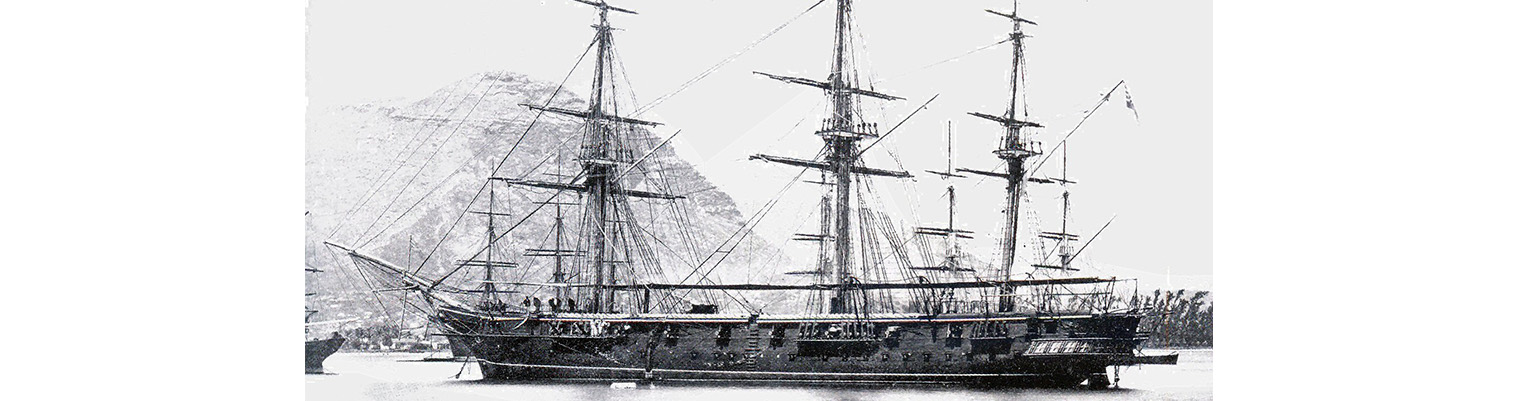
This is the story of the second ship to bear the name HMS Cossack.

Originally ordered by Russia for the Black Sea Fleet in December 1852 at a cost of 290,000 silver roubles, the ship was sold to the Hamburg trading house of Henry Mersk & Co. when relations between Britain and Russia deteriorated, as Russia feared possible confiscation.

The original contract price for the vessel, then named Witjas (Cossack), was £46,198, including £16,750 for machinery. The Admiralty subsequently paid the contractors £9,591 to complete the contract (of which £4,187 was for machinery), plus £751 for tonnage exceeding the specification and £2,206 for modifications for His Majesty’s service. The ship remained in service until 1875.

Year by Year

Discover the history of the HMS Cossack from 1854 to 1875.

You can search the ‘year’ and ‘month’ to find a specific date and also ‘click’ on the date itself to reveal any images and moments from that date.

28 July 1854

Commissioned (Partial fitting by builders) then at Chatham from 10 October 1854 for sea. Cost of fitting at Chatham £8,611.

Total cost of build £57, 730

28 July 1854

Commissioned (Partial fitting by builders) then at Chatham from 10 October 1854 for sea. Cost of fitting at Chatham £8,611

Total cost of build £57, 730

19 August 1854

Fully commissioned under Captain Edward Gennys Fanshaw for the Baltic during the Russian War

19 August 1854

Fully commissioned under Captain Edward Gennys Fanshaw for the Baltic during the Russian War

01 January 1855

01 January to 31st December 1855

In the Baltic during the early and middle part of the year

01 January 1855

1855 –

In the Baltic during the early and middle part of the year,


28 March 1855

Left the Downs on 28 March 1855

12 May 1855

Along with other vessels she is employed reconnoitring Sweaborg.

12 May 1855

Along with other vessels she is employed reconnoitring Sweaborg.

26 May 1855

ESK and COSSACK went to Hango Head and destroyed some small Russian vessels.
The fleet then went off to explore various options ie coastal towns or facilities to attack.

26 May 1855

ESK and COSSACK went to Hango Head and destroyed some
small Russian vessels. The fleet then went off to explore various options ie coastal towns or facilities to attack.

05 June 1855

COSSACK was sent back to Hango Head to land prisoners captured during the previous visit and others taken elsewhere. What followed appears to have been a bit of catastrophe as Captain Fanshawe, the Commanding Officer of the Cossack, appears not to have followed the correct procedure for sending a landing party ashore under a flag of truce which resulted in seven men in the party being killed and the others, some of whom were wounded, being taken prisoner by Russian troops, who claimed they didn&…

COSSACK was sent back to Hango Head to land prisoners captured during the previous visit and others taken elsewhere. What followed appears to have been a bit of catastrophe as Captain Fanshawe, the Commanding Officer of the Cossack, appears not to have followed the correct procedure for sending a landing party ashore under a flag of truce which resulted in seven men in the party being killed and the others, some of whom were wounded, being taken prisoner by Russian troops, who claimed they didn’t see the flag of truce (A History from the Earliest Times to the Death of Queen Victoria by Sir Wm. L Clowes: pages 480-482 refer).

“For this dastardly act, in which six of our seamen were killed, four wounded and the remainder taken prisoner, the admiral could obtain no satisfaction”.

Captain H.R. Yelverton of the ARROGAN (46 guns) therefore was sent with the MAGICIENNE (21 guns) and the gunboat RUBY to take vengeance where he could on the coast of Finland.(The British Navy by Earnest Protheroe : page 460)

( Note the difference in the number killed)

05 June 1855

COSSACK was sent back to Hango Head to land prisoners captured during the previous visit and others taken elsewhere. What followed appears to have been a bit of catastrophe as Captain Fanshawe, the Commanding Officer of the Cossack, appears not to have followed the correct procedure for sending a landing party ashore under a flag of truce which resulted in seven men in the party being killed and the others, some of whom were wounded, being taken prisoner by Russian troops, who claimed they didn&…

COSSACK was sent back to Hango Head to land prisoners captured during the previous visit and others taken elsewhere. What followed appears to have been a bit of catastrophe as Captain Fanshawe, the Commanding Officer of the Cossack, appears not to have followed the correct procedure for sending a landing party ashore under a flag of truce which resulted in seven men in the party being killed and the others, some of whom were wounded, being taken prisoner by Russian troops, who claimed they didn’t see the flag of truce (A History from the Earliest Times to the Death of Queen Victoria by Sir Wm. L Clowes: pages 480-482 refer).

“For this dastardly act, in which six of our seamen were killed, four wounded and the remainder taken prisoner, the admiral could obtain no satisfaction. Captain H.R. Yelverton of the ARROGAN (46 guns) therefore was sent with the MAGICIENNE (21 guns) and the gunboat RUBY to take vengeance where he could on the coast of Finland.(The British Navy by Earnest Protheroe : page 460) ( Note the difference in the number killed)

21 July 1855

After much “to-ing and fro-ing” by the Anglo/French fleet, COSSACK is again involved in action with other ships against some shore batteries at Frederickshamn, on the Finland (sic) Coast where some damage was caused to the enemy and their installations with little damage being caused to the attacking ships, despite several direct hits

21 July 1855

After much “to-ing and fro-ing” by the Anglo/French fleet, COSSACK is again involved in action with other ships against some shore batteries at Frederickshamn, on the Finland (sic) Coast where some damage was caused to the enemy and their installations with little damage being caused to the attacking ships, despite several direct hits,

26 July 1855

The Island of Kotka was attacked, but the garrison had already departed: barracks, stores and magazines etc were destroyed and the squadron left, leaving COSSACK in charge of the Island.

26 July 1855

The Island of Kotka was attacked, but the garrison had already departed: barracks, stores and magazines etc were destroyed and the squadron left, leaving COSSACK in charge of the Island.

09 August 1855

From 9 August to 11 August

COSSACK appears back with the Fleet in time to join in the attack on Sweaborg on, which appears to have caused much damage, but achieved little in military terms. With the prospect of winter approaching further activity in the area appears to have been aborted

09 August 1855

9 – 11 August 1855

COSSACK appears back with the Fleet in time to join in the attack on Sweaborg on, which appears to have caused much damage, but achieved little in military terms. With the prospect of winter approaching further activity in the area appears to have been aborted

Hidden Gems

The Island of Kotka was attacked in 1855, but the garrison had already departed: barracks, stores and magazines etc were destroyed and the squadron left, leaving COSSACK in charge of the Island.

Anchor crest

Receive our newsletters?